
When the Child Said — I Can’t Do Maths
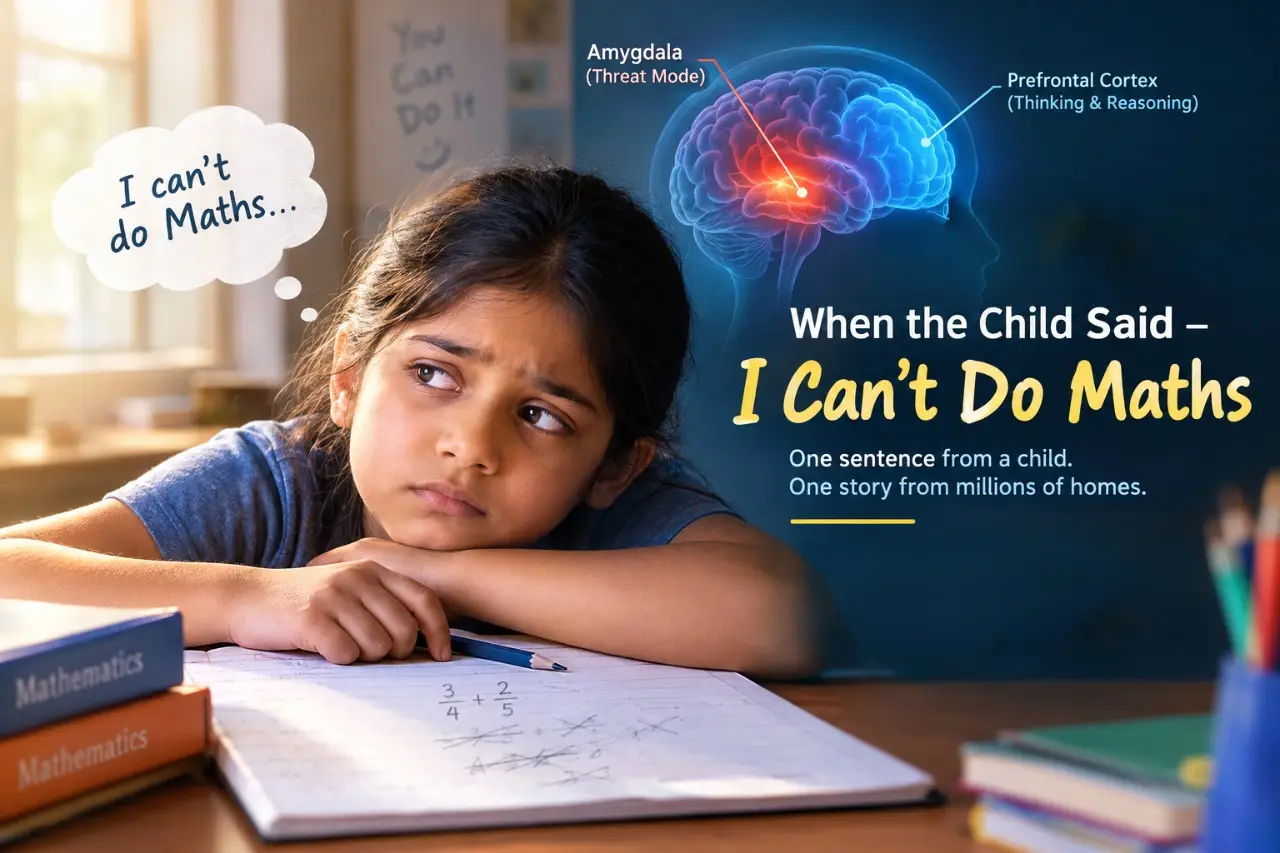
One sentence from a child. One story from millions of homes. Neuroscience, research, and education — a deep analysis.
It is seven in the evening. Darkness is settling outside. Inside the room there is the white glow of a tubelight, the slow hum of a ceiling fan, and an open maths notebook with a pencil resting on it; not picked up, just placed there.
Ten-year-old Ananya is sitting in her chair, but her eyes are not on the notebook. They are turned towards the window. Her shoulders are hunched; not the way tiredness makes you droop, but the way you bend under a weight that nobody can see. Her fingers are touching the pencil, but they cannot seem to pick it up.
On the fridge is the tuition teacher’s phone number, stuck with a magnet; third month running. Last term’s exam paper is in the desk drawer, face down so the red marks won’t show. Today’s problem is written in the notebook: 3/4 + 2/5. Ananya has tried twice. Both attempts are scratched out. She is not trying any more.
And then, in a very quiet voice; the kind that comes wrapped in shame; she says:
“मम्मी, मुझसे Maths नहीं होता।” “Mummy, I can’t do Maths.”
This sentence does not belong to Ananya alone. At this very moment, this evening, this sentence is being spoken in lakhs of homes across India; by some child, in some form. Sometimes through tears, sometimes through silence, sometimes by tearing a page from the notebook, sometimes by simply putting the pencil down. This article is an attempt to understand that one sentence; the science behind it, the fear beneath it, and what to say in that moment that might begin to ease that fear.
PART ONE
What Does This Sentence Really Mean?
When a child says “I can’t do Maths,” most adults treat it as a complaint, an excuse, or laziness. “Pay attention,” “Work harder,” “You’re not even trying”; these responses come from that understanding. But two decades of neuroscience tell an entirely different story.
What the child is saying is not “I’m lazy” or “I’m stupid.” What the child is saying is: “My brain is in threat mode right now.” And when the brain is in threat mode, the process of learning shuts down; this is not a metaphor, this is measurable neuroscience.
Amygdala Hijack: When Fear Blocks Thinking
Stanford University neuroscientist Vinod Menon and his team conducted a landmark study in 2012. They scanned the brains of children aged 7 to 9 using fMRI (functional Magnetic Resonance Imaging); at the precise moment the children were solving maths problems. What they found was startling.
In children who had math anxiety; for whom mathematics was a source of fear; the amygdala was hyperactive. The amygdala is the part of the brain that detects danger. It is the same region that lights up when an animal charges towards you, when someone shouts at you, when there is a physical threat. These children’s brains were placing a maths problem in the same category; as a threat.
At the same time, these children’s prefrontal cortex; the part of the brain responsible for logical thinking, problem-solving, and step-by-step reasoning; was shutting down. In plain terms: when fear switches on, thinking switches off. This is not “I can’t”; this is “my brain won’t let me right now.”
Research Says: fMRI scans show that in math-anxious children, amygdala hyperactivation and prefrontal cortex hypoactivation occur simultaneously. This pattern is similar to what is observed in PTSD and phobia.
— Young, Wu & Menon, Psychological Science, 2012
Working Memory: When the RAM Runs Low
University of Chicago cognitive psychologist Sian Beilock added another dimension in 2010. She demonstrated that math anxiety is not just an emotional experience; it directly impacts working memory.
You can think of working memory as your brain’s RAM. Just as a computer with low RAM causes programs to hang, when working memory is flooded with stress, mathematical processing grinds to a halt. Beilock’s research shows that anxiety can reduce working memory capacity by up to 50%.
Consider what this means: a child whose working memory can normally handle 4–5 chunks of information can manage only 2–3 chunks under anxiety. And mathematics; especially multi-step problems like fraction addition; requires 4–5 chunks. So the child is literally unable to solve the problem; not weak, but neurologically constrained.
Math anxiety reduces working memory by up to 50%. This is not weakness; it is chemistry.
— Beilock, 2010
This finding is revolutionary because it completely demolishes the “lazy child” narrative. When a child says “I can’t do it,” they are telling the truth; in that moment, in the current state of their brain, they truly “cannot.” But; and this is the most important “but”; this state is not permanent. It can be changed. What is created from the outside can also be healed from the outside.
“I can’t do it” is a neurological event, not a character flaw. When a child’s amygdala is activated, their prefrontal cortex shuts down. Fear blocks thinking.
— Vinod Menon, Stanford University, 2012
Vision: The first principle of student-centred education; understand the child’s brain first, then design the curriculum.
• • •
PART TWO
Where Does This Fear Come From?
No child is born afraid of mathematics. A two-year-old counts; “one, two, three”; and smiles with every new number. A three-year-old understands “equal” while sharing biscuits. A four-year-old finds patterns on staircases, spots geometry in floor tiles, does measurement in the kitchen. Mathematics is every child’s natural instinct. Stanislas Dehaene (2011) called this “number sense”; an innate mathematical intuition present in every human being.
So when does this natural instinct turn into fear? Research identifies three main sources; and all three lie outside the child, not inside.
Source 1: Time Pressure; Timed Tests
Sian Beilock (2014) clearly established that timed math tests; where the child must answer within a fixed time; are the single strongest predictor of math anxiety. When the clock is ticking, the brain enters “fight or flight” mode. Working memory floods with stress chemicals. The child cannot recall even what they already know.
In the Indian context, this runs even deeper. In our education system, maths = exams = time limits = marks = rank = future. It is not hard to imagine the burden this entire chain places on a child’s brain. When it takes more than 3 seconds to answer “7 x 8,” the teacher’s eyebrows rise. The child learns: in maths, “fast” is the same as “right.” And that lesson is wrong.
Research Says:Timed tests push the brain into “fight or flight” mode. The child cannot recall even what they know. Speed is not a measure of mathematical ability; yet our system treats it as one.
— Beilock & Willingham, American Educator, 2014
Jo Boaler (Stanford) has done deeper work on this subject. She has shown that timed tests not only increase anxiety but also send children a false message: “maths = speed.” Yet the world’s greatest mathematicians; Ramanujan, Einstein, Andrew Wiles; spent years on their greatest discoveries. Mathematics requires deep thinking, not fast thinking. But our examination system sends children exactly the opposite message.
CBSE, ICSE, and state board examinations typically allocate 3 hours for a maths paper containing 30–40 questions. That means 4–6 minutes per question. Can a child whose amygdala has already activated in the first 10 minutes work productively for the remaining 2 hours and 50 minutes? Research says: no.
Source 2: The Response to Mistakes; The Error Response
Carol Dweck (Stanford, 2006) has shown through decades of research that children do not fear mathematics; they fear being wrong in mathematics. And this fear depends on how mistakes are responded to.
When a child gives a wrong answer and hears “You weren’t paying attention,” they decode an implicit message: mistake = my failing. If this message is repeated, the child develops a “fixed mindset”; “I am what I am, I cannot change.” And a child with a fixed mindset avoids challenges, because every challenge threatens their “intelligence.”
Conversely, when a child is told “That approach didn’t work; let’s try another way,” the mistake shifts from being a “fault” to being “information.” Dweck calls this a “growth mindset”; “I’m here right now, but I can learn.” Children with a growth mindset in mathematics show 40% more persistence (Dweck, 2006).
Source 3: Parents’ Own Anxiety; The Homework Paradox
In 2015, Beilock’s team made a surprising discovery that can be called “The Homework Paradox”: when math-anxious parents help their children with homework, the children’s math anxiety increases; even though the parents are “helping.”
How does this happen? Because anxiety is contagious. A child does not hear words; a child hears tone. The child sees that the mother’s face is tense, the father’s voice is rising, and homework “help” has become homework “stress.” The child learns: mathematics is the thing that brings tension into the home. Mathematics = conflict.
Maloney et al. (2015) studied 438 families and found that children of math-anxious parents showed significantly lower math achievement by the end of the academic year; but only when parents had “helped” with homework. Children of math-anxious parents who were not involved in homework did not show this effect.
Research Says: Homework help from math-anxious parents increases children’s math anxiety and reduces achievement. Anxiety is contagious; the child hears not the words, but the tone.
— Maloney, Ramirez, Gunderson, Levine & Beilock, Psychological Science, 2015
This paradox runs even deeper: parents who are themselves math-anxious often push homework precisely so their child gets “good marks”; meaning their own anxiety drives them towards over-involvement. And over-involvement transfers the anxiety. It is a vicious cycle: my anxiety → more involvement → anxiety transferred to the child → child’s poor results → my anxiety increases further.
The solution is not for parents to withdraw from the child’s homework. The solution is to change the nature of their involvement; from evaluator to companion, from checker to listener. This shift is subtle, but its neurological impact is profound.
The Indian Numbers: A Broader Picture
According to ASER (Annual Status of Education Report) 2022, 57% of Class 5 children cannot perform basic division. 74% of Class 3 children cannot do two-digit subtraction with borrowing. These are not statistics about “ability”; these are statistics about the failure of a system.
Cuemath’s 2022 Global Math Anxiety Report is even more striking: 82% of Indian children aged 6–16 report math anxiety. This figure is considerably higher than the global average.
NCF (National Curriculum Framework) 2005 explicitly stated: “The curriculum must enable children to find mathematics enjoyable rather than a source of fear.” This recommendation was made in 2005; two decades ago. The data tells us that ground reality has not changed.
These numbers become even more concerning when viewed through a gender lens. Multiple studies show that math anxiety is higher in girls than in boys; this is not biological, it is cultural. When a girl hears “girls aren’t good at Maths”; whether stated directly or implied; she experiences an additional layer of threat. This is “stereotype threat,” and Claude Steele (1997) has shown that it measurably reduces performance.
57% of Class 5 children cannot do basic division (ASER 2022). 82% of children aged 6–16 report math anxiety (Cuemath 2022).
Vision: These numbers are a diagnosis, not a destiny. The day we change the system, these numbers will change.
• • •
PART THREE
Two Answers; Both Wrong
When Ananya says “I can’t do Maths,” her parents usually have two kinds of responses. Both come from a place of love. Both, according to neuroscience, make the situation worse.
Answer 1: “Pay attention. Try harder.”
This sentence assumes the child is not paying attention. In reality, a child with math anxiety is paying full attention; but their brain is focused on the fear, not on the mathematics. Menon’s (2012) fMRI data is clear: an anxious child’s brain is more “active” than any relaxed child’s; just active in the wrong region.
Telling a child to “pay attention” is like telling a drowning person to “swim.” The problem is not ability; it is the state of mind. And the state of mind cannot be changed by saying “pay attention”; it requires safety.
“Try harder” falls in the same category. Research shows that effort-based praise (“you worked hard”) can be helpful, but effort-based demand (“work harder”) when a child is already overwhelmed is harmful. Beilock (2010) showed that telling stressed children to “try harder” actually causes their performance to drop further, because the additional pressure reduces working memory even more.
Answer 2: “Your father was good at Maths”
This comparison doubles the anxiety. Mueller & Dweck (1998) showed in a classic study that when children’s intelligence is praised (“you’re so smart”), they start avoiding difficult problems; because failure would threaten their “smartness.”
When a child is told “your father was good at it,” the child hears: “you are less than him.” Or worse: “Maths ability is in the genes, and maybe you didn’t get them.” This comparison creates an impossible standard; and the child gives up before even trying.
Answer 3: “It’s okay, Maths isn’t for everyone”
This is the most dangerous sentence; because it sounds the most kind. Jo Boaler (Stanford, 2016) links this to “entity theory”: when we tell a child that “Maths isn’t for everyone,” we are giving them a fixed “math identity”; “I am the child who can’t do Maths.”
Once this identity forms, the child stops trying altogether. Why try? They have already been told this is “not for them.” Boaler’s research shows that “math identity”; “I’m not a math person”; once formed, is extremely resistant to change. It becomes a label the child carries for life.
Answer 4: “Let’s get you a tuition teacher”
This answer outsources the problem. But if the problem is anxiety; not ability; then tuition delivers the same content, the same approach, and often more pressure. ASER 2022 data shows that India’s tuition industry is growing rapidly, but math outcomes are not improving.
The problem is not with the content. The problem is with the relationship; the child’s relationship with mathematics. And relationships are not changed by tuition; they are changed by experience.
All four answers are different, but they share one thing: none of them asks the child; “Which part is difficult for you?” None of them listens to the child; all of them answer the child.
• • •
PART FOUR
So What Should We Say? What Research Tells Us
If “pay attention” is wrong, and “it’s okay” is also wrong; then what is the right answer? Research offers three evidence-backed responses. All three are simple. All three are deeply grounded.
Response 1: “Which part is difficult?”
This single sentence accomplishes three things.
First: it tells the child that you have heard them. “Pay attention” dismisses the child’s words. “Which part?” validates them. In neuroscience, this is called “social acknowledgment”; and it is the first step towards calming the amygdala.
Second: it transforms “all of Maths” into “one specific part.” “I can’t do Maths” is an overwhelming statement; the entire subject, the entire future, everything at once. “Which part?” breaks it into manageable chunks. Psychological research calls this “cognitive reappraisal.”
Third: it gives the child the opportunity to articulate their difficulty. Ramirez et al. (2016) showed that when children express their math anxiety in words; either by writing or speaking; their working memory is freed up and performance improves. What can be articulated becomes less frightening.
Research Says: When children spent 10 minutes writing about their anxiety before a test, their performance improved significantly. Articulation frees up working memory.
— Ramirez, Chang, Maloney, Levine & Beilock, 2016
Response 2: “It’s hard right now; but your brain is learning”
This is the simplest and most powerful translation of Carol Dweck’s “growth mindset.” This sentence has two parts, and both are essential.
“It’s hard right now”; this is validation. It tells the child: “Yes, this is difficult, and your experience is valid.” Many parents deny the difficulty (“It’s not that hard, just try”); this tells the child their feelings are wrong. Validation is the first step.
“Your brain is learning”; this is the reframe. It transforms “I’m stuck” into “I’m learning.” In Dweck’s research, the word “yet”; just “not yet”; measurably increased children’s persistence. Yeager & Dweck (2012) showed that children who received growth mindset interventions showed significant GPA improvement; especially those who had been low-performing.
“Yet”; just one word; increases children’s persistence by 30%+. “I can’t do it” vs. “I can’t do it yet”; the difference is one word.
— Yeager & Dweck, 2012
Response 3: “Come, let’s look at it together”
This sentence is the most important; and the most underrated. James Coan (University of Virginia, 2006) conducted a remarkable study: when participants were given the threat of an electric shock, their brain scans showed a normal threat response. But when they were given the hand of a trusted person to hold, the threat response dropped significantly. Coan called this “social buffering of the amygdala.”
“Come, let’s look at it together”; this sentence does exactly that. It tells the child: “You are not alone. I am with you; not to judge you, but to walk alongside you.” It transforms mathematics from a solitary battle into a shared journey.
And research shows this is not just emotional comfort; it is neurological change. When a child feels that someone is with them, the amygdala literally calms down and the prefrontal cortex reactivates. The child can think again.
The most powerful mathematical intervention is not a curriculum, not an app, not a tutor. It is a trusted human being who says: “Come, let’s look at it together.”
— Coan, 2006; Boaler, 2016
Research Says:Hand-holding; literal and figurative; significantly reduces the amygdala’s threat response. This “social buffering” effect is strongest when the companion is trusted and judgement-free.
— Coan, Schaefer & Davidson, Psychological Science, 2006
All three responses share a common thread: none of them tries to “fix” the child. Because the child is not “broken”; their brain is in threat mode. And the way out of threat mode is not pressure; it is safety. Specificity provides safety (“not all of Maths,” just “one part”). Growth language provides safety (“right now” = temporary). Companionship provides safety (“together” = not alone).
Vision: The day every parent receives this training, homework evenings will become conversations, not battlegrounds.
Case Study: Jo Boaler’s Mathematical Mindsets Program
Stanford University’s Jo Boaler developed the “Mathematical Mindsets” program, built on exactly these three principles: specificity, growth language, and collaborative problem-solving. Children in the program showed 2.7 years of math growth in 18 months; and this growth was greatest among children who had been in the “I can’t do math” group.
Boaler’s most important finding was this: making problems “open-ended”; allowing multiple approaches rather than one correct answer; dramatically reduced children’s anxiety. When there is “only one right way,” the fear of being wrong is enormous. When there are “many ways,” exploration becomes safe.
Finland’s Parent Education Model
Finland; which has been a consistent top performer in PISA rankings; adopted a unique approach: parent education programs. Finnish schools offer workshops to parents that teach them how to “help” with their child’s maths homework without transferring anxiety.
The core principle: parents do not need to teach mathematics. They only need to create a “safe space” where the child can make mistakes without judgement. Finnish research shows that children of parents who attend these workshops have 40% lower math anxiety compared to the control group.
Finland has another noteworthy practice: teachers never call a child “slow” or “weak”; they say “this student needs more time with this concept.” This language shift; from labelling the child to labelling the concept; protects the child’s identity. And when identity is safe, learning is possible.
Is this possible in India? Absolutely. It does not require policy change; it requires language change. And language change can begin this very evening; from your home, with your words.
• • •
PART FIVE
India’s Heritage; A Deep Paradox
This conversation would be incomplete without discussing India’s own mathematical heritage; because that heritage says exactly what modern neuroscience is saying today.
Bhaskaracharya’s Lilavati: Mathematics as Play
In the 12th century, Bhaskaracharya named his mathematics textbook “Lilavati”; after his daughter. And in it, mathematical problems were written as stories: “Tell me, dear Lilavati; if a lotus blooms in a pond and the wind bends it…” This framing was not merely literary; it was pedagogical. Bhaskaracharya understood that mathematics is learned best when it becomes a story, a game, an object of beauty; not of fear.
Aryabhata and Baudhayan: From Concrete to Abstract
Aryabhata gave the world zero and the decimal system; the highest flight of abstract thinking. But note: this abstraction arose from concrete observations. Baudhayan taught geometry through the Sulbasutras, through the construction of Vedic fire altars; by building with hands, measuring, cutting. This is exactly the approach that Singapore adopted in 1982 under the name “CPA (Concrete-Pictorial-Abstract)” and showed the world.
India did this 2,500 years ago. We are the inheritors of that very tradition.
Consider Ramanujan; one of the most extraordinary mathematicians of the twentieth century. How did he learn mathematics? The formal education system rejected him; he failed college twice. But his relationship with mathematics was one of joy, not fear. He did not “do” mathematics; he “lived” it. His notebooks contain theorems written the way someone writes a diary; personal, intimate, joyful.
Consider the contrast: the same India that produced a genius like Ramanujan today puts its children through rote memorisation and timed tests. We have not learned the most essential lesson from our own heritage: mathematics is learned when it is a source of joy, not a source of fear.
The Colonial Shift: From Tradition to Examination
So what changed? The British colonial education system transformed the guru-shishya tradition into an examination system where maths = marks = rank = selection. Mathematics went from being something to learn to being something to “pass.” And when mathematics becomes something to “pass,” the fear of “failing” is natural.
Lord Macaulay’s education policy of 1835 had an explicit objective: “a class of persons Indian in blood and colour, but English in tastes, in opinions, in morals and in intellect.” This policy replaced India’s rich guru-shishya tradition; where education happened at a personal pace, through dialogue, and through experience; with a mass examination system where the sole measure of success was marks.
This paradox is still alive today: the same country that gave the world zero is now watching its children grow up afraid of mathematics. But this does not mean we have lost; it means we have forgotten our own tradition. And what has been forgotten can also be remembered.
NEP 2020 (National Education Policy) has taken steps in this direction; emphasis on foundational numeracy, a focus on conceptual understanding, a goal of reducing examination stress. But between a policy document and classroom reality there is a vast gap; and that gap can be filled by parents and teachers, not by the government.
India gave the world mathematics. Today, 82% of India’s children are afraid of maths. This is not a failure of children; it is a failure of the system.
• • •
PART SIX
What Five Countries Did; A Glimpse
In previous articles in this series, we took a deep dive into five countries that transformed mathematics education. Here is a brief callback; because the essence of each connects directly to this article’s core message.
Finland trusted its teachers; removed timed tests, eliminated standardised exams until Class 9, and trained its teachers to master’s degree level. Result: math anxiety in Finnish children is 30% below the OECD average. Singapore changed the sequence; starting with concrete objects, moving to pictures, then to abstract symbols. This is exactly what Baudhayan did 2,500 years ago.
Japan invested in “Lesson Study”; teachers sit together to design a lesson plan, observe it in action, and refine it. Estonia demonstrated that what matters is not resources but teacher quality and curriculum design; per-student spending less than Finland’s, results comparable. British Columbia adopted “competency-based assessment”; measuring thinking, not marks.
All five countries share a common thread: they did not change the content; they changed the experience. The mathematics remained the same, but the child’s relationship with mathematics changed. And this is the very change that can happen in Ananya’s room too; this evening.
One more important point: all five countries avoided a common mistake; they did not try to solve the problem with “more content” or “harder problems.” They first ensured the child’s emotional safety, then delivered the content. This sequence is critical: Safety → Trust → Engagement → Learning. Without safety, the other three are not possible.
PISA 2018 data shows that countries where students reported the highest “sense of belonging”; Finland, Japan, Estonia; were the same countries with the lowest math anxiety and the highest math performance.
— OECD PISA 2018, Volume III: What School Life Means for Students’ Lives
Five countries did not change the content; they changed the experience. The mathematics remained the same, but the child’s relationship with mathematics changed. And changing a relationship does not require a curriculum committee; one parent is enough.
• • •
PART SEVEN
The Change Begins; This Very Evening
Reading research is one thing. Applying it at seven in the evening, in front of an open maths notebook, with a frustrated child; that is another. Here are some practical steps that can begin this very evening.
- Listen First, Speak Later. When the child says “I can’t do this”; pause for 5 seconds. Say nothing. Simply look at the child; not with a judging gaze, but with a listening one. Those 5 seconds tell the child: “What you’re saying matters.” Neuroscience tells us that this 5-second pause is the first step in reducing the amygdala response.
- Make the Problem Smaller. “Which part is difficult?”; ask this. If the child cannot articulate, guide them: “This part? Or that part?” Moving from “all of Maths” to “one specific step”; this psychological distance makes things feel manageable for the child.
- Use “Right Now” and “Not Yet.” Change “You can’t do it” to “It feels hard right now.” Change “You don’t know fractions” to “You haven’t learned fractions yet.” “Right now” and “not yet”; these two phrases open a window of possibility. Dweck’s research shows that this language shift alone increases children’s persistence by more than 30%.
- Sit Beside Them, Don’t Give the Answer. “Come, let’s look at it together”; and then sit beside the child. Not across from them, but next to them. Don’t tell them the answer. Stay with them in the process. If the child gives a wrong answer, don’t say “wrong”; say “let’s check this one more time.” Give the child the chance to discover.
- Normalise Mistakes. “Okay, that approach didn’t work; let’s try another one”; this sentence tells the child that mistake = information, not failure. Boaler’s (2016) research shows that when classroom culture treats mistakes as “learning opportunities,” math anxiety drops by up to 60%.
- Recognise Your Own Anxiety. This is the hardest step. If you are afraid of mathematics yourself; or ever were; recognise that fear. Beilock’s (2015) research is clear: your anxiety reaches the child, even if you try to hide it. If mathematics is not your strong suit, do not take on the pressure of “helping” with homework. Instead, sit with the child and say: “I find this hard too; let’s figure it out together.” This honesty gives the child two messages: one, finding it hard is normal. Two, hard does not mean “give up.”
A Small Experiment for This Evening
When your child opens their maths notebook today, do one thing:
1. Sit nearby; not across, but beside them.
2. If they say “I can’t do this”; stay quiet for 5 seconds.
3. Then simply say: “Which part is difficult?”
4. Listen. Don’t answer. Just listen.
5. Then say: “Come, let’s look at it together.”
That is all for today. One more step tomorrow. Change does not happen in one evening. But the beginning happens in one evening.
• • •
PART EIGHT
Vision: Man Making, Nation Building
Student-Centred Education: The child at the centre, not the subject
This article was about the fear of mathematics. But the real question is not about maths. The real question is: is our education system built for the child, or is the child built for the system? When a child says ‘I can’t do it’; they are not just talking about maths. They are saying: ‘There is no place for me in this system.’ Dr. A.P.J. Abdul Kalam said; ‘Man Making, Nation Building.’ This means: first build the human being, then the nation will follow. And building a human being begins with listening to a child.
Research Says: UNESCO Education 2030 Framework states; ‘Education must be learner-centred, inclusive, and lifelong.’ The OECD Future of Education 2030 Project identifies ‘Student Agency’ as a central principle of education; the child’s ownership of their own learning.
— UNESCO, 2015; OECD, 2019
2036: The Next Ten Years
Every Indian classroom will begin with the child, not the textbook. Assessment will measure growth, not memory. Every school will have a trained counsellor who treats math anxiety with the same seriousness as a physical illness. NEP 2020’s foundational literacy and numeracy mission will be fulfilled; but its success will be visible not in marks, but on children’s faces. ‘Samarth’ means ‘capable’; every child will know that they are capable.
2076: Fifty Years From Now
The walls between subjects will have fallen. Mathematics, science, language, art; these will not be separate boxes, they will be streams of the same river. Every child’s learning journey will be as unique as their fingerprints. ‘Gifted’ and ‘struggling’ will be words found only in history books; because every child will have a path designed for them. India will export not products but pedagogy; the world will come to learn how India teaches.
2126: A Hundred Years From Now
‘Math anxiety’ will be in history textbooks; like smallpox: a disease that was conquered. India will have fulfilled its ancient promise: “ विद्या ददाति विनयम् (Vidya Dadati Vinayam)” — Knowledge gives humility. Education will be regarded as humanity’s most important invention; greater than the wheel, greater than electricity, greater than the internet. Every human being will be a lifelong learner; not by choice, but by design; because the system around them will nurture perpetual curiosity. ‘Man Making, Nation Building’ will not be just Samarth Trust’s mission; it will be civilisation’s operating principle.
Every child is born loving to learn. If that love is lost, it is not the child’s failure; it is the system’s failure.
This is the first step; of listening, of understanding, of recognising the fear.
The next article will take this journey forward. To the place where mathematics is already hiding; sometimes in the kitchen, sometimes in the market, sometimes in a game. Where the child is already doing mathematics without knowing it; and would have continued, had we not frightened them by calling it “Maths.”
In Lekh 6, we will explore: how to bring mathematics back from fear to joy; the same joy that lived in Lilavati, that lived in the Sulbasutras, that still lives in every two-year-old today.
A Final Note: The Science of Patience
After reading all this, someone might ask: “How long will it take?” Research’s answer is: change does not happen overnight, but the effect of starting is visible immediately.
Dweck’s (2006) research shows that after a growth mindset intervention, measurable change in children begins to appear within 6–8 weeks; not in academic performance (that comes later), but in effort and persistence. The child starts engaging with difficult problems instead of running from them. And this shift; from running to engaging; is the foundation of learning mathematics.
Boaler’s Mathematical Mindsets program showed a similar timeline: math anxiety scores dropped significantly within 2–3 months, and academic gains appeared within 6 months. But the very first change; visible within the first week; was that children stopped saying “I can’t do it.”
So if you begin this evening; if today you say “Which part is difficult?” instead of “Pay attention”; then the seed of change has already been sown. Let it grow. Slowly. One evening, one sentence, one child; that is all.
This is the first step. The next article will take you to where mathematics is already hiding; in your kitchen.
Innovation in Education; For Every Child, From Every Home
References (21)
- Young, C.B., Wu, S.S. & Menon, V. (2012). “The Neurodevelopmental Basis of Math Anxiety.” Psychological Science, 23(5), 492–501.
- Menon, V. (2012). Stanford University fMRI Study on Mathematical Cognition. Cerebral Cortex.
- Beilock, S.L. (2010). “Math Performance in Stressful Situations.” Current Directions in Psychological Science, 19(5), 339–343.
- Dehaene, S. (2011). The Number Sense: How the Mind Creates Mathematics. Oxford University Press.
- Beilock, S.L. & Willingham, D.T. (2014). “Math Anxiety: Can Teachers Help Students Reduce It?” American Educator, 38(2), 28–32.
- Dweck, C.S. (2006). Mindset: The New Psychology of Success. Random House.
- Maloney, E.A., Ramirez, G., Gunderson, E.A., Levine, S.C. & Beilock, S.L. (2015). “Intergenerational Effects of Parents’ Math Anxiety.” Psychological Science, 26(9), 1480–1488.
- ASER Centre (2023). Annual Status of Education Report (ASER) 2022. Pratham Education Foundation, New Delhi.
- Cuemath (2022). “Global Math Anxiety Report.” Cuemath Research, Bengaluru.
- NCERT (2005). National Curriculum Framework 2005. New Delhi.
- Mueller, C.M. & Dweck, C.S. (1998). “Praise for Intelligence Can Undermine Children’s Motivation and Performance.” JPSP, 75(1), 33–52.
- Boaler, J. (2016). Mathematical Mindsets. Jossey-Bass.
- Ramirez, G., Chang, H., Maloney, E.A., Levine, S.C. & Beilock, S.L. (2016). Journal of Cognition and Development, 17(4), 508–525.
- Yeager, D.S. & Dweck, C.S. (2012). “Mindsets That Promote Resilience.” Educational Psychologist, 47(4), 302–314.
- Coan, J.A., Schaefer, H.S. & Davidson, R.J. (2006). “Lending a Hand.” Psychological Science, 17(12), 1032–1039.
- Sahlberg, P. (2015). Finnish Lessons 2.0. Teachers College Press.
- Plofker, K. (2009). Mathematics in India. Princeton University Press.
- National Education Policy 2020. Ministry of Education, Government of India.
- UNESCO (2015). Education 2030: Incheon Declaration and Framework for Action. UNESCO, Paris.
- OECD (2019). OECD Future of Education and Skills 2030: Conceptual Learning Framework. OECD Publishing, Paris.
- Kalam, A.P.J. Abdul (2002). Ignited Minds: Unleashing the Power Within India. Viking/Penguin Books India.