
5000 Years of Living Proof
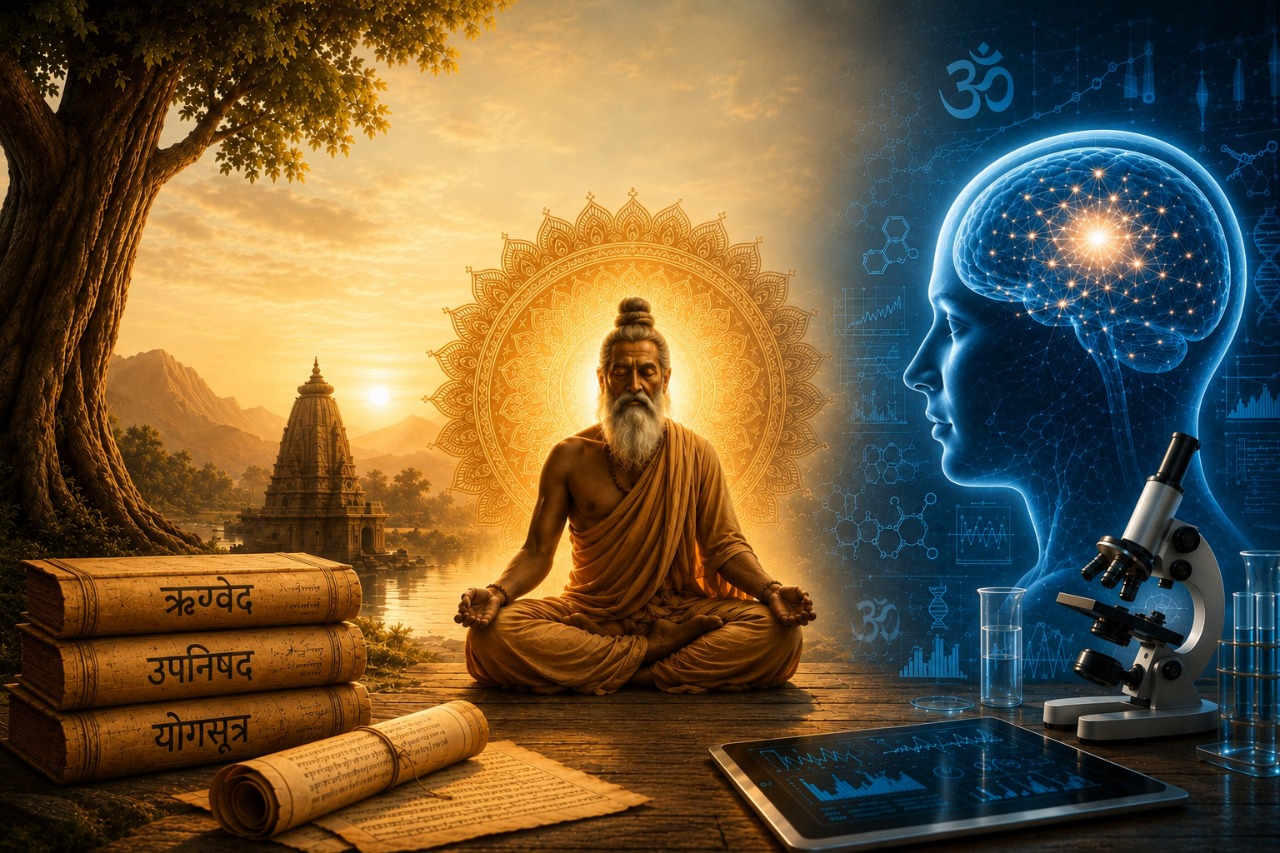
What the Rishis Knew, Science Can Now Measure — Every Civilisation Asked ‘How Does a Child Learn?’; Bharat Lived the Answer
PART ONE
The Question Every Civilisation Has Asked
A seven-year-old girl in Jharkhand sits on a mud floor. No tuition teacher. No coaching centre. No expensive books. Just a slate, a piece of chalk, and her grandmother beside her.
The grandmother cannot read. She has never been to school. She does not know what “pedagogy” means. She has never heard of neuroscience.
But every evening, she does something extraordinary.
She does not tell the child, “Learn this.” She asks, “What did you notice today?”
She does not say, “You got it wrong.” She says, “Try again. Slowly.”
She does not compare her to the neighbour’s child. She says, “Your pace is your pace.”
She does not fill the child with answers. She waits; patiently, silently; for the child to find her own.
That grandmother, sitting on that mud floor, without knowing it, is practising the most advanced principles of learning science known to humanity. This is not a metaphor. This is neuroscience.
Since the beginning of human history, every civilisation has asked the same question: How does a child learn?
Greece said: through logic. Train the mind to reason.
China said: through discipline. Repetition builds mastery.
The Islamic Golden Age said: through scholarship. Seek knowledge, even unto China.
The European Enlightenment said: through instruction. The teacher knows; the child does not.
And for the last fifty years, modern neuroscience, armed with fMRI machines, EEG scans, and controlled experiments, has been asking this same question. Billions of dollars. Thousands of laboratories. Hundreds of thousands of research papers.
Their conclusions?
A child learns best through daily practice, not cramming. Through self-belief, not fear. Through personal pace, not comparison. Through effort, not outcome. Through discovery, not instruction.
Read that list again.
Now listen to what a civilisation said thousands of years ago:
Abhyasa: daily practice
Shraddha: self-belief
Svadharma: personal pace
Karmayoga: effort over outcome
Awakening: discovery from within
The match is not approximate. It is precise.
Five thousand years ago, without a single brain scanner, without a single laboratory, without a single research grant, the rishis of Bharat arrived at exactly the same conclusions that modern science is arriving at today.
How?
Because they had something no laboratory can replicate: they observed the human mind, not from outside with instruments, but from inside, through sadhana, through meditation, through generations of lived experience with children, with students, with seekers.
They did not measure the brain. They understood the mind.
And now, for the first time in human history, the instruments have caught up with the insight.
• • •
PART TWO
What “Knowing” Means: Two Different Paths to the Same Truth
Before we go further, one thing must be clear.
This is not an article that says, “India was right, the West was wrong.” That framing is lazy, and it is false.
Truth does not belong to any civilisation. It belongs to reality. And reality does not change based on who discovers it first.
When Bharat’s rishis said “Abhyasena tu Kaunteya”; through practice, the mind is mastered; they were observing a truth about the human brain. When Dr. Michael Merzenich at the University of California demonstrated in 2013 that repeated practice physically rewires neural pathways, he was measuring the same truth.
The rishi observed. The scientist measured. The truth was always there.
Think of it this way: a mother knows her child has a fever by touching the forehead. A doctor confirms it with a thermometer. The mother was not less accurate. The doctor was not more knowledgeable. They arrived at the same fact through different instruments.
Bharat’s instrument was sadhana; inner observation refined over millennia.
Modern science’s instrument is technology; brain scans refined over decades.
Different instruments. Same truth.
• • •
PART THREE
Ten Truths the Rishis Knew; and Science Can Now Measure
In the previous article in this series, we presented 10 Bhartiya principles that form the foundation of a Growth Mindset. Those principles came from the Gita, the Upanishads, Patanjali, Shankaracharya, and Kapila Muni.
Now, we place each of those principles next to modern scientific research. Not to validate one with the other; but to show that they are, and always were, the same truth seen from two directions.
1. Karmayoga: Focus on Effort, Not Outcome
कर्मण्येवाधिकारस्ते मा फलेषु कदाचन।
Karmanyevadhikaraste ma phaleshu kadachana
Your right is to action alone, never to its fruits.
Shrimad Bhagavad Gita (2.47)
In 2017, Professors Edward Deci and Richard Ryan at the University of Rochester published four decades of research into what they call Self-Determination Theory. Their central finding: when a person’s motivation comes from the process itself; the joy of doing, not the reward of finishing; performance improves dramatically, creativity increases, and the person persists longer through difficulty.
They identified three core needs: autonomy (I choose to do this), competence (I am getting better), and relatedness (this connects me to others). When these three needs are met, the brain releases dopamine not at the moment of reward, but during the process of effort itself.
Krishna told Arjuna: focus on the action, not the fruit. Deci and Ryan told the world: intrinsic motivation outperforms extrinsic motivation. The language changed. The truth did not.
But here is what the Gita adds that science has not yet fully explored: Nishkama Karma; action without desire. Not “I will enjoy the process” (which is still a form of desire), but “I will act because acting is my dharma.” This is a level of motivation that Western psychology has not yet named. It is beyond intrinsic. It is existential.
2. Shraddha: Self-Belief Precedes Knowledge
श्रद्धावाँल्लभते ज्ञानम्।
Shraddhavan labhate jnanam
Only one with shraddha attains knowledge.
Shrimad Bhagavad Gita (4.39)
In 1977, Professor Albert Bandura at Stanford University introduced the concept of “self-efficacy”; the belief in one’s own ability to succeed at a specific task. His research showed something remarkable: self-efficacy is a stronger predictor of academic performance than actual ability. A child who believes they can learn, learns. A child who believes they cannot, does not; regardless of their IQ.
A 2011 meta-analysis published in Psychological Bulletin reviewed 53,000 students and confirmed: self-efficacy consistently predicts achievement across subjects, ages, and cultures. The effect is not small. It is among the strongest predictors in all of educational psychology.
The Gita’s warning is even stronger: “Samshayatma vinashyati”; the one paralysed by doubt is destroyed. Not “slowed down.” Destroyed.
But shraddha, as the rishis understood it, operates deeper than self-efficacy. It functions at three levels: belief in oneself, belief in the path, and belief in the guide. Bandura’s model covers only the first. The full architecture of shraddha is richer, and science has only begun to explore the other two layers.
3. Abhyasa: Daily Practice Rewires the Brain
अभ्यासेन तु कौन्तेय वैराग्येण च गृह्यते॥
Abhyasena tu Kaunteya vairagyena cha grihyate
Through practice and detachment, the mind is mastered.
Shrimad Bhagavad Gita (6.35)
In 2013, Dr. Michael Merzenich; the neuroscientist who won the Kavli Prize for his work on brain plasticity; demonstrated that the adult brain is not fixed. It physically changes in response to repeated experience. When you practise something daily, the neural pathways responsible for that skill become thicker, faster, and more efficient. When you stop practising, they weaken.
He called it “competitive plasticity”; your brain is constantly being reshaped by whatever you repeatedly do. If you repeatedly fear mathematics, the fear pathways grow stronger. If you repeatedly practise mathematics with curiosity, the mastery pathways grow stronger.
This is Abhyasa; described without a brain scanner, thousands of years ago.
But the Gita pairs Abhyasa with something that neuroscience is only beginning to understand: Vairagya; detachment. Dr. Judson Brewer at Brown University has shown that attachment to outcomes activates the brain’s default mode network; the part associated with rumination, anxiety, and self-referential worry. Detachment; Vairagya; quiets this network, freeing cognitive resources for actual learning.
Abhyasa builds the skill. Vairagya protects the builder.
4. Sanskara: Every Action Leaves an Imprint
Bhartiya philosophy teaches that every action leaves a sanskara; an imprint on the mind. Old sanskaras can be overwritten with new ones.
In 2006, Dr. Jeffrey Karpicke at Purdue University demonstrated something that surprised the education world: the most effective way to learn is not re-reading, not highlighting, not summarising; it is retrieval practice. The act of pulling information out of memory strengthens the neural trace far more powerfully than putting information in.
This is sanskara theory in laboratory language. Every act of retrieval carves a deeper groove. Every repetition strengthens the imprint. And the old imprint; the fear, the confusion; fades as the new one grows stronger.
Dr. Robert Bjork at UCLA added another dimension: “desirable difficulties.” When learning feels slightly hard; when there is a struggle to retrieve; the resulting memory is significantly stronger than when the answer comes easily. Struggle is not the enemy of learning. It is the mechanism.
The rishis called this Tapas; the inner fire that comes from enduring difficulty. Not punishment. Purification.
5. Svadharma: Every Child Has Their Own Path
स्वधर्मे निधनं श्रेयः परधर्मो भयावहः॥
Svadharme nidhanam shreyah, paradharmo bhayavahah
It is better to walk your own path imperfectly than to walk another’s path perfectly.
Shrimad Bhagavad Gita (3.35)
In 2016, Professor Todd Rose at Harvard published “The End of Average,” a book that dismantled one of education’s most dangerous assumptions: that there is an “average” student. His research showed that when you design for the average, you design for no one. Every brain has a unique “jaggedness profile”; strong in some areas, developing in others.
The U.S. Air Force discovered this in the 1950s when they measured 4,063 pilots across 140 body dimensions and found that not a single pilot was “average” on all dimensions. When they redesigned for adjustability; for individual difference; performance soared.
Education systems worldwide still design for the average child. One pace, one method, one test, one standard. The Gita told us millennia ago: this is Paradharma; the imposition of someone else’s path. And it is bhayavaha; dangerous.
Svadharma is not just philosophy. It is how the brain actually works.
6. Titiksha: Endurance Without Complaint
Shankaracharya’s Titiksha: Fall, rise, and do not complain.
In 1994, Dr. Robert Bjork introduced the concept of “desirable difficulties”; the idea that learning conditions which make initial performance harder actually lead to better long-term retention and transfer.
His student, Dr. Elizabeth Ligon Bjork, extended this research to show that students consistently misjudge their own learning: what feels easy and fluent is often poorly retained, while what feels difficult and slow is often deeply retained. The feeling of struggle is not a sign of failure; it is a sign of learning.
This is Titiksha; the understanding that difficulty is not the obstacle. It is the path.
No Western research framework has yet captured this distinction. Resilience acknowledges the struggle. Grit celebrates the persistence. Titiksha transcends both; the struggle itself disappears as a category. This is an insight that science has not yet measured, but millions of practitioners have lived.
7. Vairagya: Detachment Frees the Mind to Learn
“अभ्यासेन तु कौन्तेय वैराग्येण च गृह्यते”॥
Abhyāsena tu Kaunteya vairāgyeṇa ca gṛhyate.h
The restless mind is restrained through constant practice (Abhyasa) and detachment (Vairagya). Abhyasa with Vairagya; practice with detachment.
Shrimad Bhagavad Gita
In 2015, Dr. Judson Brewer at Brown University used real-time fMRI scans to show that the brain’s “default mode network”; the system that activates when we worry about ourselves; directly interferes with learning and performance. When this network is active, the prefrontal cortex; the seat of reasoning and creative thinking; is suppressed.
When a child sits in an exam hall, terrified of failing, their default mode network floods the brain with anxiety. The prefrontal cortex; the very part they need for solving problems; goes quiet. The child “goes blank.” Not because they do not know the answer. Because their brain’s worry system has shut down their thinking system.
Vairagya; practise without attachment to the result; is not spiritual advice. It is a neurological strategy.
8. Triguna: The Mind Is Not Fixed, It Shifts
Kapila Muni’s Sankhya philosophy describes three states: Tamas (inertia), Rajas (agitated activity), and Sattva (calm clarity).
In 2007, Dr. Mary Helen Immordino-Yang at USC’s Brain and Creativity Institute published research showing that emotional states directly determine the quality of learning. Fear or apathy (Tamas): the amygdala dominates, higher-order thinking shuts down. Anxious competition (Rajas): learning happens but is shallow. Genuine curiosity and calm engagement (Sattva): the deepest learning occurs. p>
Her 2016 paper demonstrated that it is neurologically impossible to learn deeply without positive emotional engagement. The brain does not have a “thinking part” and a “feeling part” that operate independently. Cognition and emotion are woven together at every level.
Kapila Muni described this architecture without a brain scanner.
And Patanjali’s Pratipaksha Bhavana; immediately replacing a negative thought with its opposite; is now studied under the name “Cognitive Reframing” in clinical psychology. Patanjali prescribed it two thousand years ago.
9. Yogah Karmasu Kaushalam: Skill Through Deliberate Practice
योगः कर्मसु कौशलम्॥
Yogah karmasu kaushalam
Excellence in action is yoga.
Shrimad Bhagavad Gita (2.50)
In 1993, Dr. K. Anders Ericsson at Florida State University published one of the most influential papers in learning science: “The Role of Deliberate Practice in the Acquisition of Expert Performance.” His finding: what distinguishes experts from novices is not talent, not intelligence; it is the accumulated hours of deliberate, focused, feedback-rich practice.
Not just practice. Deliberate practice; practice with intention, with attention to weakness, with continuous refinement. A child who solves 50 problems mindlessly learns less than a child who solves 10 problems mindfully.
The Gita’s “Kaushalam” includes something that even Grit theory does not: the injunction that skill development itself is the purpose. Not the trophy. Not the ranking. The progressive mastery of the craft. Yoga is not the destination. Yoga is the quality of the journey. ━━━
10. “Each Soul Is Potentially Divine”: The Brain Has No Known Limit
Vivekananda said: “Each soul is potentially divine. The goal is to manifest this divinity within.”
In 2007, Dr. Norman Doidge published “The Brain That Changes Itself”; a book that revolutionised our understanding of neural potential. His case studies documented people who recovered from stroke by rerouting brain functions, blind people who learned to “see” through their tongues, and elderly people who reversed cognitive decline through targeted practice.
His conclusion: the brain’s capacity for reorganisation and growth appears to have no fixed limit. The old model; that each person has a fixed “intelligence” determined by genetics; has been comprehensively overturned.
The Chandogya Upanishad said “Tat Tvam Asi”; You are That. Doidge said: the brain’s potential for change is, as far as we can measure, limitless.
Different words. Same truth. One spoken in a forest in ancient Bharat. The other written in a laboratory in Toronto.
The child is not limited. The child has never been limited. The only thing that was limited was our understanding of the child.
• • •
PART FOUR
The Deepest Divide; Why “Fill” Fails and “Awaken” Works
Everything in the preceding ten sections leads to one insight. It is the same insight that runs through every article in this series. And now, for the first time, we can state it in the language of brain science:
When you “fill” a child; lectures, rote memorisation, passive absorption; only one brain system is primarily activated: the hippocampus, which handles short-term memory storage. The information enters. It sits. And within days, it fades.
When you “awaken” a child; through curiosity, through self-discovery, through struggle, through practice; multiple brain systems activate simultaneously: the prefrontal cortex (reasoning), the hippocampus (memory), the anterior cingulate cortex (error detection), the basal ganglia (habit formation), and; crucially; the brain’s emotional systems. The information does not just enter. It integrates. It becomes part of how the child thinks.
Dr. Stanislas Dehaene, Chair of Experimental Cognitive Psychology at the Collège de France, identifies four “pillars of learning” in his 2020 book: attention, active engagement, error feedback, and consolidation. Notice: not one of these pillars is “listening to a lecture.” Not one is “copying from the board.” Not one is “memorising a formula.”
Every single one requires the child to be an active participant, not a passive receiver.
This is what Vivekananda meant when he said, “Education is the manifestation of the perfection already in man.” He was not speaking metaphorically. He was describing; with extraordinary precision; how the brain actually learns.
The rishis called it Awakening.
Neuroscience calls it Active Learning.
The mechanism is identical.
• • •
PART FIVE
Not Just Mathematics. Not Just India. Every Child, Everywhere.
If these principles were only about mathematics, they would be interesting but limited.
They are not limited.
Dr. Bandura’s self-efficacy research was conducted across mathematics, science, reading, sports, and professional performance. Shraddha works everywhere.
Dr. Merzenich’s neuroplasticity research applies to language acquisition, musical training, physical rehabilitation, and cognitive development. Abhyasa works everywhere.
Todd Rose’s “End of Average” research began with Air Force pilots, moved to educational policy, and now informs workplace design at Google and Microsoft. Svadharma works everywhere.
These are not “Indian” principles applied to mathematics. These are universal truths about how the human brain learns; truths that Bharat articulated first, that modern science is confirming now, and that apply to every child, in every subject, in every country.
• A child in Finland learning music benefits from Abhyasa.
• A child in Brazil learning to read benefits from Shraddha.
•A child in Japan learning science benefits from Svadharma.
• A child in Nigeria learning language benefits from Sanskara.
And a child in Jharkhand; sitting on a mud floor with her grandmother; benefits from all of them. Because her grandmother, without knowing any of these words, was practising all of them.
This is what makes Bharat’s contribution unique. Not that it discovered these truths. Truth cannot be “owned.” But that it wove these truths into the fabric of everyday life; into the relationship between grandmother and grandchild, between guru and shishya, between parent and child; so deeply that even an unlettered woman on a mud floor practises them naturally.
That is not a theory. That is a civilisation.
• • •
PART SIX
What You Can Do; Starting Tomorrow
This article is not meant to be only intellectual. If these principles are true; and five thousand years of lived experience and fifty years of laboratory science both say they are; then they should change something in your life. Starting now.
For Parents:
• Replace “What marks did you get?” with “What did you learn today?” This single shift; from outcome to process; activates your child’s intrinsic motivation system. The brain rewards effort when the environment rewards effort. Change the question, change the brain.
n.
• Stop comparing. When you say “Sharma ji ka beta scored 95,” you are activating your child’s default mode network; the worry system; and suppressing their prefrontal cortex; the thinking system. Comparison does not motivate. It paralyses. Svadharma is not philosophy. It is neurology.y.
• Ten minutes daily is more powerful than two hours on Sunday. This is the spacing effect; one of the most replicated findings in all of cognitive science. Short, consistent practice builds stronger neural pathways than long, infrequent cramming. Make practice a daily ritual, like brushing teeth. Abhyasa.
For Teachers:
• Ask before you tell.When you ask a question and wait; even if the silence is uncomfortable; you activate retrieval practice in every student’s brain. The difference in retention is a factor of two to three times. Let the child struggle. The struggle is the learning.
• Notice emotion before content. If a child is afraid, their amygdala has shut down their prefrontal cortex. No amount of explanation will reach them. First, create safety. First, build shraddha. Then teach. The sequence matters; it is a neurological necessity./p>
For Every Reader:
The next time someone tells you that “Indian philosophy is nice but not scientific”; know that this is no longer a defensible statement. The evidence is in. The rishis’ observations and modern science’s measurements have converged. The question is no longer “Is this true?” The question is: “Are we practising it?”
• • •
PART SEVEN
From Knowledge to Practice; The Bridge That Matters
Everything in this article; every principle, every research finding, every convergence between ancient wisdom and modern science; leads to one question:
How does a child practise this every day?
Not once a year in a seminar. Not once a week in a classroom. Every day. Because Abhyasa means daily. Because neuroplasticity requires repetition. Because sanskaras are formed through consistency, not intensity.
Every principle discussed in this article is not just a philosophy within the app; it is a design decision. Adaptive difficulty that respects each child’s Svadharma. Daily practice sessions that honour Abhyasa. A system that rewards effort and consistency, not marks and rankings; Karmayoga in code. An environment where getting a problem wrong is not failure but a natural part of the learning process; Titiksha, built into the experience.
The app does not teach a child what to think. It creates the conditions for the child to awaken their own thinking. That is the difference between filling and awakening. And that difference; as this article has shown; is not just philosophical. It is neurological.
Maths Genius 2026, powered by Samarth Trust in partnership with the Indian Council of Historical Research, is one expression of this living tradition; a platform where children across Bharat experience these principles not as theory but as daily practice.
But the principles themselves belong to no platform, no organisation, no competition. They belong to every child. They always have.
• • •5000 years ago, a rishi sat in a forest and observed how the mind works.
Today, a neuroscientist sits in a laboratory and measures how the brain works.
They are looking at the same thing.
• One called it Abhyasa. The other calls it neuroplasticity.
• One called it Shraddha. The other calls it self-efficacy.
• One called it Svadharma. The other calls it the science of individuality.
• One called it Awakening. The other calls it active learning.
The instruments changed. The truth did not.
And somewhere in Jharkhand, a grandmother still touches her grandchild’s forehead and says, “Try again. Slowly. Your pace is your pace.”
She is right. She has always been right.
Five thousand years of living proof.
“उत्तिष्ठत जाग्रत प्राप्य वरान्निबोधत”
Arise. Awake. And stop not until the goal is reached.
— Katha Upanishad