
The Homework Evening
A Timeline of One Evening – 6:45 to 9:00 PM. When Homework Time Becomes a Battlefield.
Prologue
The Evening that Repeats in Every Home
In millions of Indian homes, a drama plays out every evening. The characters are always the same; a parent, a child, and a mathematics notebook. The story is always the same too; it begins with ‘homework done?’ and ends with tears, frustration, or silence. Sometimes all three.
This article is about that evening. We have written it as a timeline; from 6:45 PM to 9:00 PM. Because the problem of homework is not abstract; it unfolds minute by minute, in real time, in real homes, with real consequences.
At each timeslot, we have placed two things: ‘what happens now’ and ‘what could happen instead.’ Because we know that parents love their children; they just don’t always know what to do differently. This article shows the difference; with research backing every claim.
Research says: homework time affects a child’s relationship with mathematics more than the classroom itself. Because the classroom has thirty children; the parent has one. That one-to-one interaction, every evening, is where the child decides: ‘Can I do Maths, or can I not?’
“Homework is not an academic activity; it is a family experience. And every evening, that experience either connects the child to mathematics or breaks the connection.”— Harris Cooper, Duke University
Let’s begin this evening.
• • •
Finding 01
6:45 PM – The Child Opens the School Bag
It is quarter to seven. Ten-year-old Aryan is back from school. His bag is still on his back. Shoes still on, he sits at the dining table. Mother says from the kitchen: ‘Change your clothes first!’ He doesn’t hear; or pretends not to.
Aryan opens the bag. Notebooks come out one by one. Hindi; fine. EVS; easy. Then the notebook that is always at the bottom, as if it wants to stay hidden; the mathematics notebook.
Something is happening here that is invisible. The child has not read a single question. Has not done a single calculation. But his body has already released cortisol; the stress hormone. His brain has begun preparing for what it expects: difficulty, failure, and a parent’s disappointment.
Research Says
Anticipatory anxiety; when the mere expectation of a difficult task triggers a stress response; is most commonly observed in mathematics. Lyons & Beilock (2012) found that for math-anxious individuals, anticipating math activates the same brain regions (posterior insula) as physical pain. The pain is not metaphorical; it is neurologically real.
Aryan’s mother comes from the kitchen. She sees the open bag. She sees the maths notebook. And she says the sentence that is the first spark of the evening:
“So? What homework is there today?”
• • •
Finding 02
7:00 PM – “Homework Done?”
‘Homework done?’; this is the most universal question in Indian homes. The moment a child is visible in the evening, this is asked. It is not just a question; it is a check, an inspection, a signal that the evening’s real purpose is about to begin.
The problem is not that the question is asked. The problem is how the child hears it:
- Parent means: ‘Tell me, what needs to be done today?’
- Child hears: ‘Why haven’t you done it yet?’
- Parent means: ‘I can help.’
- Child hears: ‘Now you will be inspected.’
Sian Beilock’s (2015) research makes a startling claim: when math-anxious parents help their children with homework, the children’s own math anxiety increases and their achievement drops; even though the parents are ‘helping.’ Anxiety is contagious. The child absorbs the parent’s frustrated voice, their tension, their body language.
Notice: the pencil has not been picked up yet. The child has not done any mathematics. But the brain has already entered stress mode. Learning has not started; but the barriers to learning are fully in place.
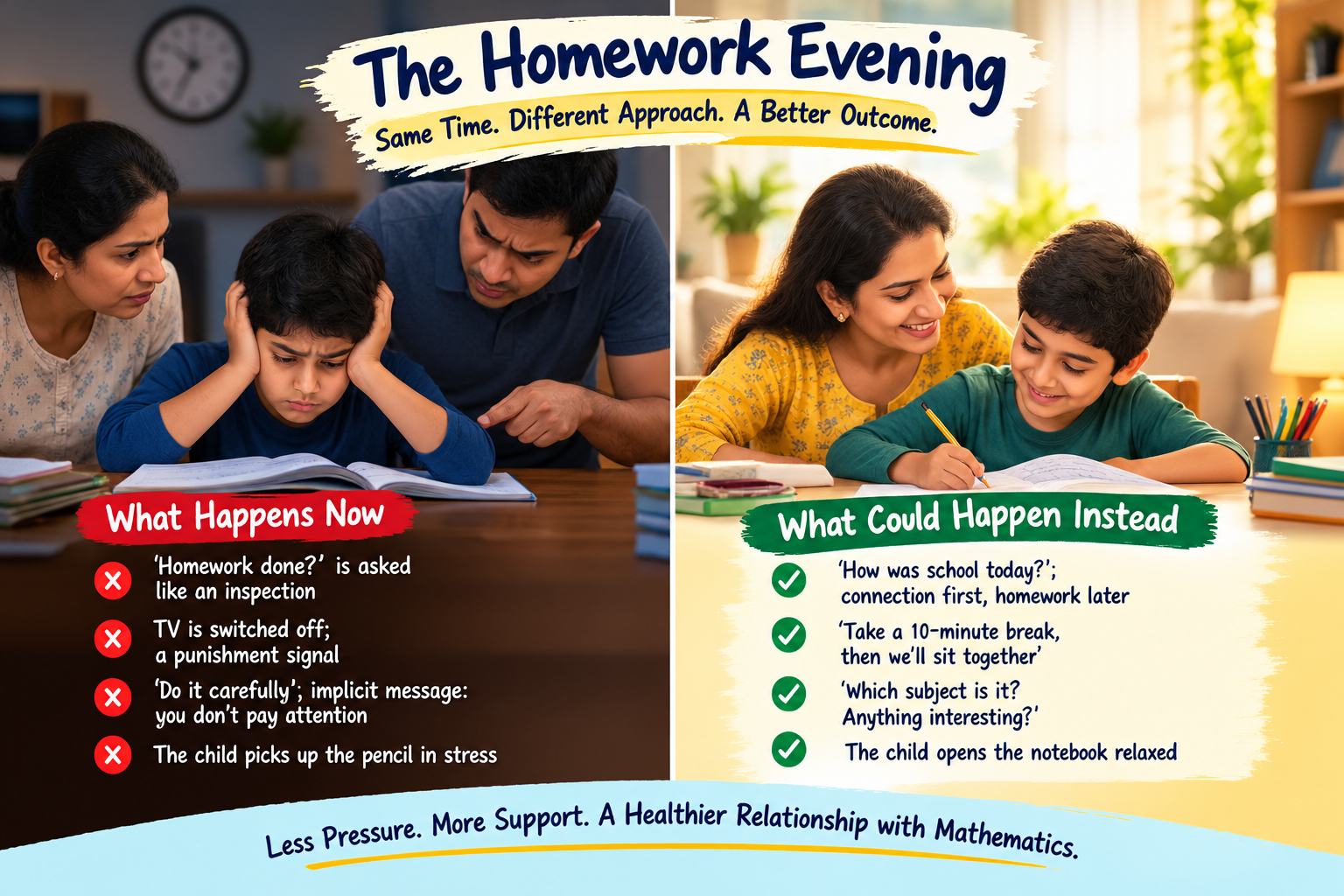
What happens now
- ‘Homework done?’ is asked like an inspection
- TV is switched off; a punishment signal
- ‘Do it carefully’; implicit message: you don’t pay attention
- The child picks up the pencil in stress
What could happen instead
- ‘How was school today?’; connection first, homework later
- ‘Take a 10-minute break, then we’ll sit together’
- ‘Which subject is it? Anything interesting?’
- The child opens the notebook relaxed
• • •
Finding 03
7:15 PM – “This is so Simple!”
Aryan has opened Exercise 7.3. Fractions. The question is: 3/4 + 2/5 =? He stares at the notebook. Nothing makes sense. LCM? He has heard the word but cannot remember the steps. His pencil hovers over the page; not writing, just hovering.
Father comes from behind. Glances at the notebook. And says the sentence that is the single largest contributor to mathematics fear in Indian children:
“This is so simple! You can’t even do this? Find the LCM and add. That’s it!”
This sentence is said with love. Father genuinely believes it is simple; because for him it is. Thirty years of mathematical experience has made fractions automatic. But what is automatic for the adult is genuinely difficult for the ten-year-old.
Research Says
Expertise blindness (the ‘Curse of Knowledge’): Experts find it difficult to estimate what novices find hard; because they can no longer remember what it was like not to know. (Camerer, Loewenstein & Weber, 1989)
When the child hears ‘this is so simple,’ they decode three things:
- This is easy; so, if I can’t do it, I must be stupid.
- Everyone else can do it; so, I’m the only one who can’t.
- Father is getting irritated; so, I need to hurry. Understanding doesn’t matter, just finishing does.
Ramirez et al. (2016) found that parents’ emotional responses; especially frustration and impatience; are a stronger predictor of a child’s math anxiety than the actual difficulty of mathematics. The child is not afraid of the problem; the child is afraid of the reaction.
Cognitive load theory (Sweller, 1988) tells us that what seems ‘simple’ to an adult is genuinely complex for a child’s brain. The child’s working memory has limited capacity; it cannot simultaneously handle the LCM procedure, keep track of two fractions, manage the parent’s expectations, and process anxiety. Something must give; and usually, it is understanding.
A neuroscience fact: when the child’s eyes fill with tears, their amygdala is fully activated. In this state, the prefrontal cortex; where mathematical reasoning happens; effectively shuts down. The parent is asking the child to solve a fraction problem. The child’s brain is solving a survival problem.
If the world’s most successful countries are reducing homework, why are we increasing it?
• • •
Finding 04
7:30 PM – Voices Rise
Fifteen minutes have passed. Two out of ten questions are done; both wrong. Father’s voice is gradually rising. Mother is watching from the kitchen; she wants to intervene but knows it will make things worse.
Father is now standing; behind the child. This body language is itself a signal. When an adult stands over a child, the child’s body reads it as dominance, not support. The stress response intensifies.
Now a critical moment arrives. Father has taken the notebook. He is solving the problem himself; ‘Look, this is how you do it’; and the child is watching. Not learning. Just watching. Because the child is not processing mathematics anymore; the child is processing the emotion: relief that the pressure has moved from them, and shame that they couldn’t do it alone.
Research Says
Diamond (2013) established that executive functions; working memory, cognitive flexibility, inhibitory control; are the first casualties of stress. When cortisol rises, the prefrontal cortex reduces activity. The child literally cannot think clearly; not because they lack intelligence, but because their brain’s thinking centre has been chemically suppressed.
What happens now
- Father stands over the child, looking down
- Takes the notebook and solves it himself
- ‘Look, this is how you do it’; child becomes passive observer
- Child nods: ‘Yes, I understand now’ (a lie)
- Cortisol spike; learning impossible
What could happen instead
- Sit beside the child; at eye level
- ‘How did you do the first two? Tell me’
- Let the child identify the steps themselves
- On a mistake: ‘Interesting; what happened here?’
- Calm voice; cortisol down, learning possible
This escalation moment is the most critical. If the parent pauses here; literally a 10-second pause; much can change. That pause is not weakness. It is self-regulation; and it models for the child the very skill they need to learn.
• • •
Finding 05
7:45 PM – Mother is Watching from the Kitchen
In Indian homes, the homework evening has a third character who often stays silent; the other parent. In most homes, this is the mother. She is not sitting at the table, but she is watching everything. Every raised voice, every frustrated sigh, every tear.
Gender dynamics play an important role here. According to the OECD (2015), in most countries, math homework help is primarily the father’s domain. When the mother steps in, she often begins with: ‘Leave it, I’ll explain’; but many mothers carry their own math anxiety.
The mother who grew up hearing ‘I can’t do Maths’ (we explored this in detail in Lekh 6) unknowingly transmits the same belief to her child; especially to daughters. Beilock et al. (2010) found that female teachers’ math anxiety directly predicts their female students’ math achievement. The same dynamic operates at home.
A subtle but powerful intergenerational transmission is happening here. Mother has not directly said ‘you can’t do Maths.’ But her body language, her avoidance, her deference to the father on math questions; the child reads all of it. And internalises it.
Research Says
Gunderson et al. (2012) found that parents who hold gender-specific math stereotypes have children; especially daughters; who perform worse in mathematics and show higher math anxiety. The parents don’t need to say anything explicitly; their behaviour alone transmits the stereotype.
The solution is simple but difficult: the mother needs to address her own math anxiety. This does not mean she needs to learn calculus. It means sitting with the child and saying: ‘I don’t know this either; let’s figure it out together.’ This one sentence breaks the intergenerational chain.
• • •
Finding 06
8:00 PM – “Leave it, the Tutor Will Do it Tomorrow”
The homework battle has gone on for more than 45 minutes. Four out of ten questions are done; two wrong. Father is exhausted. Mother is exhausted. Aryan is exhausted. And then comes the sentence that ends the evening:
“Leave it. Get it done at tuition tomorrow. Sharma sir will explain.”
India’s private tutoring industry is the largest in the world; estimated at over ₹1.5 lakh crore (USD 18 billion). This industry is not built on children’s weakness; it is built on parents’ helplessness. The evening’s failure is the tutoring industry’s marketing.
When Does Tutoring Work, and When Doesn’t it?
It would be wrong to say tutoring is always useless. Research says that targeted tutoring; where a specific skill gap is identified and addressed through one-on-one instruction; can produce remarkable results. Bloom’s (1984) 2 ‘Sigma Problem’ showed that one-on-one tutoring can move a student from the 50th percentile to the 98th.
But most Indian tutoring is not one-on-one. It is batch tutoring; 20–30 children in a room, the same rote method, the same ‘solve and check’ approach. This is not tutoring; this is a second school. And a second school does not fix what the first one broke.
- Tutoring works: when there is a specific concept gap (e.g., fractions, decimals)
- Tutoring works: when it is one-on-one or small group
- Tutoring doesn’t work: when the problem is anxiety, not understanding
- Tutoring doesn’t work: when it replaces the parent’s relationship with Maths
- Tutoring causes harm: when the child receives the message ‘you can’t do it alone’
The biggest problem is that tutoring tries to address an emotional problem with an academic solution. When the child’s fear is of mathematics, another teacher teaching more mathematics does not remove the fear; it deepens it.
A ₹1.5 lakh crore tutoring industry; is this success, or a receipt for the system’s failure?
• • •
Research
How Necessary is Homework, Really?
Here, an uncomfortable question must be asked: is homework really as necessary as we believe? Harris Cooper (Duke University); who conducted the most comprehensive meta-analysis of homework research; found something surprising:
| Level | Effect on achievement | Optimal |
|---|---|---|
| Primary (Class 1–5) | Almost zero correlation with achievement | 10–20 min or none |
| Middle (Class 6–8) | Moderate positive effect | 30–60 min maximum |
| High School (Class 9–12) | Clear positive effect | 90–120 min maximum |
John Hattie (2012) synthesised 800+ meta-analyses in ‘Visible Learning’ and found that homework’s overall effect size is just 0.29; well below the 0.40 ‘hinge point’ that indicates meaningful impact. For primary school, the effect is near zero.
The Type of Homework Matters
Cooper’s research makes another important point: not all homework is equal.
- Practice homework (the most common in India; ‘solve Q1 to Q10’); least effective. This is rote repetition, not understanding.
- Preparation homework (read tomorrow’s topic beforehand); moderate effect. The child comes to class ready.
- Extension homework (find a real-life problem at home where fractions are used); most effective. This builds understanding and connects mathematics to life.
What Do Other Countries Do?
| Country | Homework | Result |
|---|---|---|
| Finland | Almost zero homework until age 10 | PISA Top 10 |
| Japan | Structured, short; 30 min/day | TIMSS Top 5 |
| USA | Varies, trending toward less | Average |
| India | 2–3 hours daily avg | Not in PISA |
Finland; consistently counted among the world’s best education systems; gives almost no homework to children under 10. Japan keeps homework short and structured. China’s ‘Double Reduction’ policy (2021) legally capped homework time.
Research Says
OECD (2014) PISA analysis: there is no correlation between countries that spend the most time on homework and countries that perform the best. In fact, the trend is slightly inverse; countries with less homework often perform better.
Research says homework’s effect size is just 0.29; for such low returns, is the child’s entire evening worth it?
“Sit Besides, Not Above”; The Scaffolding Approach
In 1976, three researchers; Wood, Bruner, and Ross; developed a concept that remains the most powerful idea in education: scaffolding. Just as scaffolding supports a building during construction and is removed when the structure can stand on its own, educational scaffolding supports the child during learning and is gradually withdrawn as the child becomes independent.
Vygotsky’s (1978) Zone of Proximal Development (ZPD) is the foundation of this concept: every child has a zone; what they can do alone, and what they can do with help. The gap between the two is where learning happens. The parent’s role is to operate in that zone; not below it (too easy) and not above it (too hard).
5 Scaffolding Techniques; for Mathematics Homework
- “Ask, don’t tell”
‘What do you think the first step would be?’ Give the child a chance to think. Even if they say something wrong, ask: ‘Interesting; why do you think so?’ Wrong thinking is still thinking. - “Let the child lead”
The notebook stays in the child’s hand. The pencil stays in the child’s hand. You describe, they write. ‘Solve it for me step by step’; this makes the child the teacher, and teaching is the deepest form of learning. - “Celebrate the process, not the answer”
‘You found the LCM correctly; brilliant!’ Instead of ‘the answer is right; good.’ When the process is celebrated, the child wants to repeat the process. When only the answer is celebrated, the child fears getting the answer wrong. - “Set a time limit; for yourself, not the child”
‘We’ll sit for 20 minutes today; whatever gets done, gets done. The rest tomorrow.’ This reduces pressure and teaches the child that understanding matters more than completion. - “I don’t know either; let’s find out”
This is the most powerful sentence a parent can say. It tells the child: not knowing is normal. The parent doesn’t need to be an expert. The parent needs to be a co-learner.
“The best teacher is not one who knows everything; it is one who is willing to journey through not-knowing alongside the child.”— Lev Vygotsky (adapted)
• • •
Finding 07
8:30 PM – Sleep, Stress, and Homework: The Evening’s Biology
It is now 8:30 PM. Homework is still not finished. Dinner is getting cold. The child is exhausted. And a biological clock is ticking; one that no parent can override.
According to the National Sleep Foundation, children aged 6-13 need 9-11 hours of sleep. If the child needs to wake up at 6:30 AM, they should be asleep by 9:00-9:30 PM at the latest. Homework that extends past 8:30 is not just educationally questionable; it is biologically harmful.
- Cortisol (stress hormone) suppresses melatonin (sleep hormone) production. After stressful homework, the child cannot fall asleep easily; even when the lights are off, the brain is still in alert mode.
- Sleep deprivation can reduce the next day’s learning capacity by up to 40% (Walker, 2017).
- The next day the child understands less in class → more homework struggle in the evening → more stress → less sleep... a vicious cycle begins.
Research Says
Matthew Walker (Why We Sleep, 2017): “Sleep is the single most effective thing we can do to reset our brain and body health each day.” Sleep deprivation does not merely cause tiredness; it fundamentally impairs the brain’s ability to form new memories and consolidate learning.
Several countries have understood this. Finland, Denmark, and Norway have adopted policies of giving primary school children no homework or very little; partly to protect sleep. China’s ‘Double Reduction’ policy legally caps homework time: 60 minutes for grades 3–6, 90 minutes for grades 7–9.
Optimal homework timing research says something simple: homework should happen early in the evening; between 4:00 and 5:30 PM; when cortisol is at its natural daily low and the brain is more receptive. By 8:00 PM, the brain is preparing for sleep. Forcing mathematics at this hour is like asking someone to run a sprint just before bed.
• • •
The Second Evening: Same Home, Three Small Changes
Now let us relive that same evening; but with three small changes. Same Aryan, same maths notebook, same Exercise 7.3. What changes is the approach; and the approach changes everything.
6:45 PM – The Bag Opens (Take Two)
Aryan opens the bag. Sees the Maths notebook. Same discomfort; same fractions. But today, Mother asks first: ‘How was school? Anything fun happen?’ They talk; about lunch, about friends, about the PT period. Five minutes. No mention of homework.
What do these five minutes achieve? They establish connection. The child feels: ‘Mum and Dad are interested in me; not in my homework.’ Emotional co-regulation research (Eisenberg, 1998) shows that a calm, connected adult presence downregulates the child’s stress response.
7:00 PM – Homework, Sitting Together
Father says: ‘Let’s see; 20 minutes. First, you try 5 minutes on your own; do what you can, skip what you can’t. Then we’ll sit together.’
Five minutes later: ‘How did it go? Which ones did you solve? Where did you get stuck?’ Aryan says; ‘Q1 is done, Q2; I can’t figure out the LCM.’
Notice what changed: Father did not give the answer. He guided the process. ‘What is LCM? What does LCM of 4 and 5 mean?’; The child thinks. ‘A number both divide into?’; ‘Good. What’s the smallest such number? Try: 10? Does 4 go into 10? No. 15? No. 20? Yes! And 5? Yes!’ The child found 20 himself. This ‘eureka moment’; when the child discovers the answer through their own thinking; releases dopamine. The brain marks this experience as rewarding. Fractions have become slightly less terrifying.
7:20 PM – A Mistake, But a Different Reaction
On Q4, Aryan makes an error. 3/4 + 2/5 should be 15/20 + 8/20 = 23/20, but he has written 5/9 (adding numerators and denominators separately; a classic misconception).
Father says: ‘Interesting! Let’s check; if I have 3 out of 4 pieces and 2 out of 5 pieces, do I have 5 out of 9 pieces? That doesn’t feel right, does it? Where do you think the thinking went differently?’
The mistake happened; but it was not turned into a ‘failure.’ It was turned into an ‘interesting discovery.’ Boaler’s (2016) research says: when mistakes are treated as learning opportunities, the brain’s neural pathways for that concept actually become stronger.
7:35 PM – 20 Minutes Done. Stop.
‘Done; 20 minutes are up. Four questions completed; very good. The rest tomorrow morning or tomorrow evening. Now eat dinner and play.’
Aryan is surprised: ‘But the other 6 questions?’ Father says: ‘They’ll get done too. But today you understood LCM; that’s more important than the other 6 questions.’
This is a radical shift; from completion to understanding. And research supports it. Cooper found that for Class 5, 10–20 minutes of focused homework is optimal. Beyond that, diminishing returns set in rapidly; and past 60 minutes, the effect can actually become negative.
The First Evening (what happens every day)
- 45+ minutes of homework
- 3+ escalation moments
- Child did 10 questions, 4 wrong
- Cortisol high, melatonin suppressed
- Child went to sleep stressed
- Next day: even more fear of Maths
The Second Evening (three changes)
- 20 minutes of focused homework
- Zero escalation
- Child did 4 questions, understood LCM
- Cortisol normal, dopamine released
- Child went to sleep relaxed
- Next day: slightly less fear of Maths
• • •
Finding 08
9:00 PM – The Day Ends, Questions Remain
It is nine o’clock. In both evenings, the child is now in bed. But one child is in stress, the other at ease.
One child’s mind says: ‘I can’t do Maths. Papa got angry too. Tomorrow the same thing will happen.’ The other child’s mind says: ‘I understood LCM. Tomorrow I’ll do the rest. It wasn’t that bad.’
The difference was just three things:
- Connection first, homework second; 5 minutes of conversation about how school was. The child is a human being, not a homework machine.
- Guide, don’t solve; ask the child, let the child think. The notebook and pencil stay in the child’s hands.
- Set a time limit; 20 minutes. Whatever gets done, gets done. Quality over quantity. Understanding over completion.
The homework evening is one of the most important evenings in a child’s life. This is the evening when the child decides: ‘Can I do mathematics?’ The answer depends not on the textbook; it depends on the adult sitting next to them.
A Deeper Question: Who Is Homework For?
When we talk about homework, a fundamental question must be asked: who is homework for? For the child? For the teacher? For the parents? Or for the system?
In most Indian schools, homework is a compliance mechanism; it is given so that children ‘do something’ at home, so that parents see the school is ‘teaching,’ and so that the syllabus is ‘covered.’ The child’s learning is secondary; institutional optics are primary.
Alfie Kohn (2006) argued in ‘The Homework Myth’ that homework; especially at the elementary level; contributes nothing to academic achievement. He went further: it damages children’s natural curiosity and love of learning.
This is an extreme position, and not all researchers agree. But there is consensus on one point: homework is only effective when it is meaningful, age-appropriate, and supported; not punitive, excessive, or anxiety-inducing.
The Parent’s Role: What Research Says
Patall, Cooper & Robinson (2008) conducted a comprehensive review of parental homework involvement and found that the type of involvement determines the outcome:
- Autonomy-supportive involvement (providing structure, encouragement, and resources); POSITIVE effect
- Controlling involvement (giving answers, applying pressure, monitoring performance); NEGATIVE effect
- Direct instruction (teaching the child yourself); MIXED effect; depends on the parent’s own competence and anxiety level
The most interesting finding: parents who are directly less involved in homework but emotionally supportive (‘let me know if you need help,’ ‘I’m here if you get stuck’) produce better outcomes than parents who sit and ‘teach’ every night.
The reason is psychological: when parents sit and ‘teach’ every night, the child hears an implicit message: ‘you can’t do it alone.’ When parents provide a supportive presence without hovering, the child hears: ‘you are capable, and you are not alone.’ Both messages are needed together; just one is not enough.
“The best homework support is the kind that makes the child feel: ‘you are capable, and you are not alone.’ Both messages must come together; just one is not enough.”— Adapted from Patall, Cooper & Robinson, 2008
Today’s Experiment
The 5-Minute Rule
This evening, make one rule:
For the first 5 minutes of homework, the child works alone.
You sit nearby; but say nothing. Don’t watch, don’t interrupt.
After 5 minutes, ask:
“What was fun? Where did you get stuck?”
Only explain as much as was asked. The rest can wait until tomorrow.
And most importantly: after 20 minutes; no matter what; stop.
Say: “That’s enough for today. You did well.”
That’s it. Just that. Today, just that.
Looking Ahead
Sitting together reduces fear. But the greatest reduction in fear happens when the child plays; and learns mathematics without knowing it. The next article is about those games.
Probability in Pachisi. Number sense in Ashta-Changa. Angular momentum in Lattu (the spinning top). Estimation in Gilli-Danda. Mathematics was always a game; we turned it into a punishment. The next article brings it back to play.
Every evening, millions of homes see the same scene; a crying child, an exhausted mother, unfinished homework. How will we fix this? Whose evening is it; the child’s, or the system’s?
Innovation in Education; For every child, from every home
• • •
Sources
References
1) Cooper, H. (2006). “The Battle Over Homework: Common Ground for Administrators, Teachers, and Parents.” Corwin Press. Meta-analysis of homework research spanning 1987–2006.
2) Lyons, I.M. & Beilock, S.L. (2012). “When Math Hurts: Math Anxiety Predicts Pain Network Activation in Anticipation of Doing Math.” PLoS ONE, 7(10), e48076.
3) Lyons, I.M. & Beilock, S.L. (2012). “Mathematics Anxiety: Separating the Math from the Anxiety.” Cerebral Cortex, 22(9), 2102-2110.
4) Maloney, E.A., Ramirez, G., Gunderson, E.A., Levine, S.C. & Beilock, S.L. (2015). “Intergenerational Effects of Parents’ Math Anxiety on Children’s Math Achievement and Anxiety.” Psychological Science, 26(9), 1480-1488.
5) Ashcraft, M.H. & Kirk, E.P. (2001). “The Relationships Among Working Memory, Math Anxiety, and Performance.” Journal of Experimental Psychology: General, 130(2), 224-237.
6) Camerer, C., Loewenstein, G. & Weber, M. (1989). “The Curse of Knowledge in Economic Settings: An Experimental Analysis.” Journal of Political Economy, 97(5), 1232-1254.
7) Ramirez, G., Chang, H., Maloney, E.A., Levine, S.C. & Beilock, S.L. (2016). “On the Relationship Between Math Anxiety and Math Achievement in Early Elementary School.” Journal of Cognition and Development, 17(4), 508-520.
8) Sweller, J. (1988). “Cognitive Load During Problem Solving: Effects on Learning.” Cognitive Science, 12(2), 257-285.
9) Diamond, A. (2013). “Executive Functions.” Annual Review of Psychology, 64, 135-168.
10) Wood, D., Bruner, J.S. & Ross, G. (1976). “The Role of Tutoring in Problem Solving.” Journal of Child Psychology and Psychiatry, 17(2), 89-100.
11) Eisenberg, N., Cumberland, A. & Spinrad, T.L. (1998). “Parental Socialization of Emotion.” Psychological Inquiry, 9(4), 241-273.
12) OECD (2015). “The ABC of Gender Equality in Education: Aptitude, Behaviour, Confidence.” OECD Publishing, Paris.
13) Beilock, S.L., Gunderson, E.A., Ramirez, G. & Levine, S.C. (2010). “Female Teachers’ Math Anxiety Affects Girls’ Math Achievement.” Proceedings of the National Academy of Sciences, 107(5), 1860-1863.
14) Gunderson, E.A., Ramirez, G., Levine, S.C. & Beilock, S.L. (2012). “The Role of Parents and Teachers in the Development of Gender-Related Math Attitudes.” Sex Roles, 66(3-4), 153-166.
15) KPMG & Google (2017). “Online Education in India: 2021.” KPMG India. Industry estimates based on multiple sources including IMARC Group.
16) Bloom, B.S. (1984). “The 2 Sigma Problem: The Search for Methods of Group Instruction as Effective as One-to-One Tutoring.” Educational Researcher, 13(6), 4-16.
17) Hattie, J. (2012). “Visible Learning for Teachers: Maximizing Impact on Learning.” Routledge. Effect sizes for homework (0.29).
18) Vygotsky, L.S. (1978). “Mind in Society: The Development of Higher Psychological Processes.” Harvard University Press.
19) Walker, M.P. (2017). “Why We Sleep: Unlocking the Power of Sleep and Dreams.” Scribner.
20) China State Council (2021). “Opinions on Further Reducing the Burden of Homework and Off-Campus Training for Students in Compulsory Education.” (Double Reduction Policy).
21) Boaler, J. (2016). “Mathematical Mindsets: Unleashing Students’ Potential through Creative Math, Inspiring Messages and Innovative Teaching.” Jossey-Bass.
22) Kohn, A. (2006). “The Homework Myth: Why Our Kids Get Too Much of a Bad Thing.” Da Capo Press.
23) Patall, E.A., Cooper, H. & Robinson, J.C. (2008). “Parent Involvement in Homework: A Research Synthesis.” Review of Educational Research, 78(4), 1039-1101.