
Mistake ; The First Step of Learning
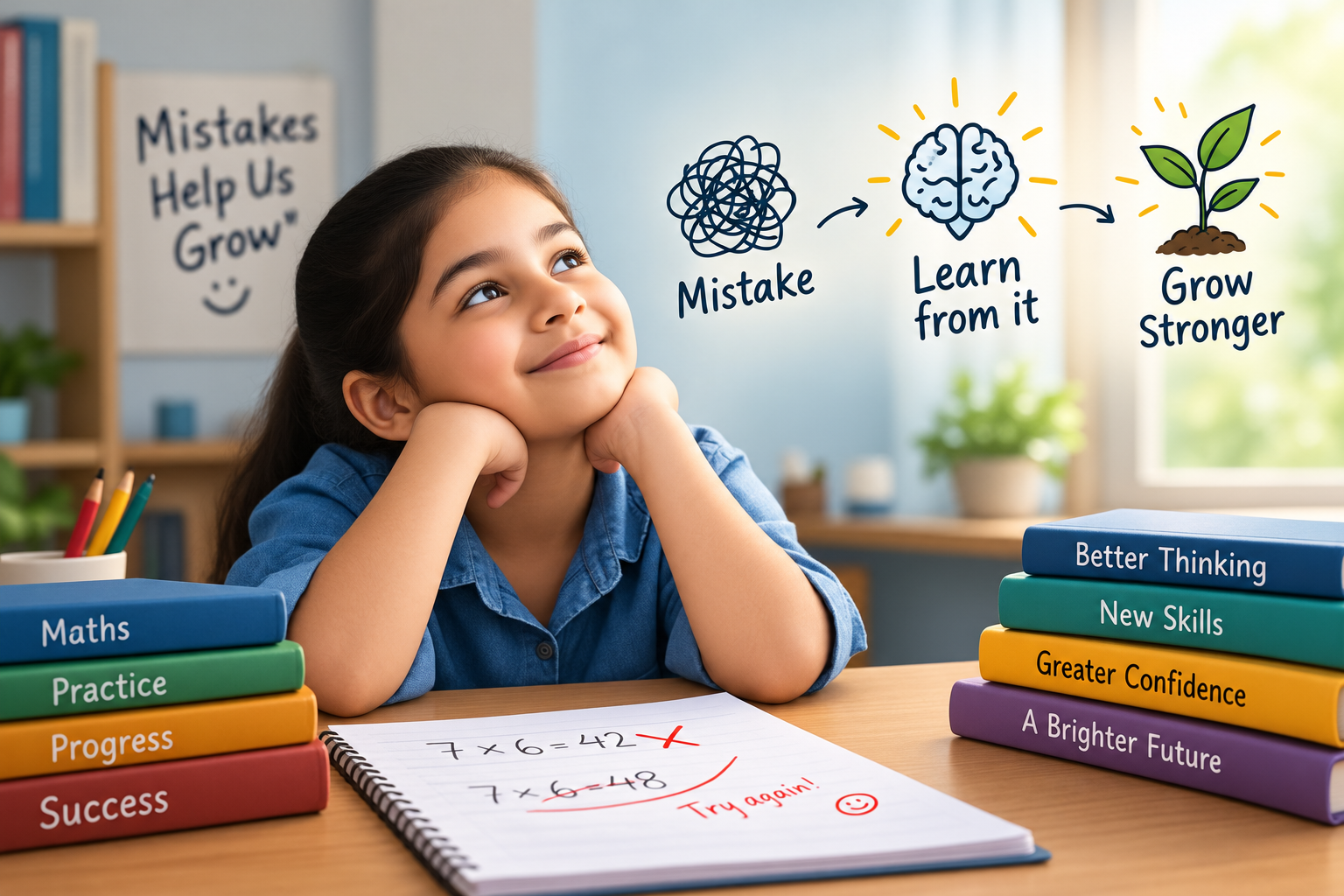
Seven Findings from Neuroscience, Cognitive Psychology, and Education Research
ABSTRACT
Seven Findings, One Message
This article presents seven findings from neuroscience, cognitive psychology, and education research. Each finding challenges a common assumption about mistakes in mathematics. Each finding is documented, replicated, and published in peer-reviewed journals. The purpose of these findings is to show parents, teachers, and policymakers that a mistake in mathematics is not a failure; it is the most important stage in the process of learning.
In India, where board exams, competitive entrance tests, and marks-based ranking have turned mistakes into defects, these findings are especially urgent. The National Curriculum Framework 2005 stated plainly: "Fear of mathematics is more serious than the difficulty of mathematics itself." Two decades later, nothing has changed; if anything, coaching culture and WhatsApp-era parenting have made it worse.
This article does not advocate any ideology. It presents research in its original language, with data, sample sizes, effect sizes, and experimental designs. The judgment is the reader's.
• • •
FINDING 01
The Brain Learns More from Mistakes
In 2011, Michigan State University psychologist Jason Moser and his team published an EEG study that triggered a paradigm shift in education research. Twenty-five participants were given simple cognitive tasks while EEG electrodes measured their brain activity. The researchers were tracking two specific neural signals.
The first signal was ERN ; Event-Related Negativity. This is the brain's first response when it detects an error. ERN fires within 50–100 milliseconds of a mistake, so fast the person doesn't even know yet that they made one. It is the brain's automatic error-detection system, located in the anterior cingulate cortex (ACC).
The second signal was Pe ; Error Positivity. This arrives 200–500 milliseconds after ERN, and it is far more significant. Pe is the signal that shows the brain is "paying attention" to the error, learning from it. Pe reflects the brain's conscious processing of the mistake.
Moser's most important discovery: both signals ; ERN and Pe ; were significantly stronger after errors than after correct responses. In plain language: the brain is more active when it is wrong than when it is right.
But that is not the whole story. Moser divided participants into two groups based on their mindset, using Carol Dweck's (2006) framework. Those with a growth mindset, who believed intelligence can change, showed a significantly larger Pe signal. This means the brains of growth-mindset individuals learn more from errors because they pay more attention to them.
The brain shows greater neural activity after errors than after correct responses; Moser et al., 2011
Study: Neural Mechanisms of Error Processing in Growth vs Fixed Mindset
Moser, J.S., Schroder, H.S., Heeter, C., Moran, T.P. & Lee, Y.H. (2011); Psychological Science, 22(12), 1484–1489
Growth mindset individuals showed enhanced Pe (Error Positivity) amplitude, indicating greater conscious attention to errors and enhanced error-correction learning. The brain literally grows more from mistakes when the individual believes growth is possible.
N=25, EEG measurement, Flanker task paradigm, within-subjects design
The implications are profound. If the brain learns more from mistakes, then our education system ; which punishes mistakes ; is literally obstructing the brain's learning process. When we put a red cross on a child's answer, we are stopping the brain from doing what it naturally wants to do: learn from errors.
"A mistake is a signal to the brain that an opportunity to learn something new has arrived. When we punish mistakes, we punish learning."
; Jo Boaler, Mathematical Mindsets, 2016
• • •
FINDING 02
Red Marks Shut the Brain Down
Every Indian child shares one experience: the notebook comes back and wrong answers are covered in big red crosses (✗). Sometimes the entire answer is struck out. Sometimes "careless" or "redo" is scrawled in the margin. The practice is so normal that nobody questions it.
But research tells a very different story. John Hattie, researcher at the University of Melbourne, analysed 800+ meta-analyses covering 52,000+ studies and 80+ million students. His 2012 Visible Learning framework is the largest empirical database in education.
Hattie divided feedback into two categories: evaluative feedback and descriptive feedback. Evaluative feedback tells you "you are right or wrong" ; marks, grades, cross marks, rankings. Descriptive feedback tells you "you are here, you need to get there, and the next step is this."
The difference in effect sizes is staggering:
An effect size of 0.40 is considered the "hinge point" in education ; above that, the impact is meaningful. Evaluative feedback sits at 0.12, nearly negligible.
Descriptive feedback sits at 0.73, almost double the hinge point. This means that when we give a child a cross mark, we are doing almost nothing. When we tell them "you forgot to invert the fraction in the second step; try again from here," we are six times more effective.
Study: Visible Learning ; A Synthesis of Over 800 Meta-Analyses Relating to Achievement
- Source: Hattie, J. (2012); Routledge, London. Updated in Visible Learning: The Sequel (2023)
- Feedback is among the most powerful influences on achievement, but its effects are highly variable. Task-specific, process-oriented feedback that shows the student where they are relative to the goal has the highest effect on learning.
- Synthesis of 800+ meta-analyses, 52,000+ studies, 80M+ students globally
The Indian Context: The Culture of the Red Pen
In India, evaluative feedback is not merely dominant; it is institutionalised. Negative marking in board exams and competitive tests like JEE and NEET ; where wrong answers cost marks ; teaches children that mistakes have a price. CBSE, ICSE, and state board answer sheets carry cross marks and a total at the bottom; that is the entire "feedback."
By contrast, countries like Finland and Japan have adopted an entirely different approach:
This comparison is not about elevating one country over another. It is about showing that alternatives exist, and they produce measurably better outcomes. Finland sits consistently in the PISA top 5; Japan in the TIMSS mathematics top 3 ; both without a punitive marking culture.
• • •
FINDING 03
Japan Made Mistakes Part of the Curriculum
In 1999, James Stigler and James Hiebert published a groundbreaking book: The Teaching Gap. It begins with the TIMSS Video Study ; the largest classroom observation study in history, in which 231 mathematics classrooms across the USA, Germany, and Japan were video-recorded.
What they found shocked American and German researchers. Japanese mathematics classes were fundamentally different, and at the centre of that difference was the role of mistakes.
Lesson Study: Designing Mistakes
Japan has a teaching practice called "Lesson Study" (jugyou kenkyuu). In this practice, teams of 3–6 teachers collaborate to design a single lesson. The process takes 3–6 weeks.
The most critical component: the teacher deliberately chooses problems where students will give wrong answers. This is not random. The teacher predicts in advance which misconceptions will surface, which mistakes students will make. Specific errors are listed in the lesson plan ; errors the teacher "wants."
Why? Because in Japanese teaching philosophy, errors are learning material. A correct answer shows one right path. An error reveals ten wrong paths, and by comparing them, the correct approach is understood far more deeply.
Neriage: The Respectful Analysis of Mistakes
During the lesson, after students have attempted the problems ; right and wrong answers both ; a structured discussion called "neriage" (練り上げ) takes place. Literal translation: "polishing up" or "kneading," like kneading dough.
In neriage, the teacher places multiple student solutions on the board ; correct and incorrect ; and asks the class: "What is similar about these approaches? What is different? Which one is correct, and why?" The student who gave the wrong answer is not embarrassed. Their contribution is valued because their mistake gave the entire class an opportunity to think.
Study: TIMSS 1999 Video Study
Stigler, J.W. & Hiebert, J. (1999); The Teaching Gap. Free Press, New York
In Japanese 8th-grade mathematics classes, 44% of problems presented were of high procedural complexity, compared to 17% in US classes. Japanese teachers spent 15+ minutes on a single problem, using student errors as the primary vehicle for deepening understanding. US teachers averaged 2–3 minutes per problem with immediate correction of errors.
231 classrooms across 3 countries, 8th-grade mathematics, random national samples
Japan's TIMSS mathematics score sits consistently in the global top 3. And the foundation of their teaching approach is this: a mistake is not a problem; a mistake is a lesson.
• • •
FINDING 04
Finland: No Marks for Eleven Years
Finland's education system is counted among the most successful in the world. From 2000 to 2012, Finland sat consistently in the PISA top 5 ; in mathematics, reading, and science. But the most remarkable fact is that Finland achieved this without any standardised testing, without ranking, and without competitive exams.
Pasi Sahlberg, former Director General of the Finnish Ministry of Education, explained in detail what Finland did and why in his 2011 book, Finnish Lessons.
Teacher Preparation: The Foundation of Trust
In Finland, every teacher ; from primary school to high school ; must hold a Master's degree. Teaching is a highly competitive profession, harder to enter than medical or law school. Only the top 10% of graduates are accepted into teaching programmes.
The direct impact: teachers have full authority over assessment. They decide what a child has learnt and what they have not. No external standardised test overrides their professional judgment. And when teachers are trained to see errors as learning opportunities, the classroom culture changes fundamentally.
Assessment Philosophy: Formative, Not Summative
In the Finnish system, children face no standardised test until the age of 16. From 7 to 16; nine years (grades 1–9); with no external exam. Teachers assess, but their assessment is not marks-based. In primary school (grades 1–5, ages 7–11), numerical grades are not given at all.
- No ranking system; students are not measured against each other
- No national test (until age 16); teachers design their own assessments
- Purpose of assessment: "where is the student and where do they need to go," not "how many marks did they score"
- Teachers use observation, conversation, portfolio, and project-based assessment
- Parents receive narrative descriptions, not marks ; strengths, growth areas, and next steps
The result: children are not afraid of mistakes. When no marks are being cut, no ranking is falling, no comparison is happening, the child tries freely, fails freely, and learns freely. This is exactly the environment that maximises Moser's (2011) Pe signal.
Study: Finnish Lessons ; What Can the World Learn from Educational Change in Finland?
Sahlberg, P. (2011, 2015, 2021; Third Edition); Teachers College Press, Columbia University
Finland’s education reforms since the 1970s eliminated standardised testing, abolished tracking before age 16, invested heavily in teacher preparation, and created an assessment culture focused on formative feedback rather than summative grades. The result was sustained excellence across all socioeconomic groups.
National policy analysis, 1970–2020, comparative education framework
"In Finland, the purpose of evaluation is not to rank students but to help each child find a path to learning."
; Pasi Sahlberg, Finnish Lessons, 2011
Japan made mistakes into pedagogy; we made mistakes into humiliation;the results speak for themselves.
• • •
FINDING 05
Productive Failure ; Being Wrong the Right Way
In 2014, Indian-origin researcher Manu Kapur introduced a counterintuitive concept into education research: "Productive Failure." Kapur, then at the National Institute of Education, Singapore (now at ETH Zurich), conducted a series of experiments that challenge conventional teaching wisdom.
Kapur's experimental design was simple: a "Direct Instruction" group taught the concept first and then given practice, and a "Productive Failure" group given problems first ; with no instruction ; followed by concept teaching.
The Productive Failure students struggled initially. They tried wrong approaches, generated incorrect solutions, became frustrated. On short-term performance measures, the Direct Instruction group performed better.
But on delayed tests ; taken 1–2 weeks later ; the Productive Failure group consistently and significantly outperformed. And when problems were novel, not identical to those practised, the gap grew even larger. The Productive Failure group performed 30–45% better on transfer tasks.
Study: Productive Failure in Learning Math
Kapur, M. (2014); Cognitive Science, 38(5), 1008-1022
Students who attempted to solve novel math problems before receiving instruction significantly outperformed those who received direct instruction first on conceptual understanding and transfer measures, despite performing worse during the initial phase. The struggle itself; the generation and exploration of failed solution attempts; prepared the mind to learn more deeply.
Quasi-experimental, 7th-grade mathematics (rate, ratio), N=109, Singapore schools
Why Does Productive Failure Work?
Kapur identifies three mechanisms:
- Activation: Struggle activates prior knowledge; even if incomplete or incorrect. This activation provides a “hook” for later instruction.
- Awareness of gaps: When a student fails, they discover what they do not know. This gap awareness makes later instruction targeted and meaningful.
- Exploration: Generating multiple solution attempts; even wrong ones; explores the problem space. This exploration builds deep structural understanding.
The implications for Indian education are profound. Our entire system is built on "Direct Instruction" ; the teacher tells, the student does. Productive Failure suggests that the exact opposite approach ; "do first, understand later" ; produces deeper learning. But it requires a fundamental shift: the willingness not just to tolerate mistakes, but to welcome them.
If Edison failed 1,000 times before inventing the light bulb, why do we stop a child at one mistake?
• • •
FINDING 06
Parents' Reactions ; The Biggest Factor
When a child gives a wrong answer in mathematics, the parent's first reaction ; that instant, automatic response ; shapes the child's mathematical future. This may sound dramatic, but the research supports it.
In 2015, Sian Beilock and her team at the University of Chicago published a landmark study: when math-anxious parents help their children with homework, the children's math anxiety increases and their math achievement drops, even though the parents are "helping." Anxiety is contagious. The child absorbs the parent's frustrated voice, their tension, their body language.
Five Common Indian Responses ; and Their Neuroscience
- "Pay attention."This response assumes the child is not focusing. But math anxiety research (Beilock, 2010) shows that the anxious child’s attention is fully engaged; just in the wrong place. Their brain is focused not on mathematics but on their anxiety, their fear of failure, and the parent’s reaction. Saying “pay attention” is like telling someone stuck in a traffic jam to “drive faster”; the problem is not capability, it is conditions.
- "This is basic." When a parent says “this is basic,” the child hears: “this is easy and you still can’t do it; you are even weaker than I thought.” This response minimises the child’s struggle and amplifies shame. Research on evaluative vs supportive responses (Gunderson et al., 2013) shows that acknowledging struggle; “yes, this is the hard part”; increases the child’s persistence.
- "Your brother/sister could do this…"Sibling comparison is extremely common in Indian homes. But Dweck & Mueller’s (1998) classic research shows that social comparison undermines motivation. When compared to a sibling, the child develops a “performance goal orientation”; “I must look good”; instead of a “learning goal orientation”; “I must learn.” Performance goals increase anxiety and reduce the risk-taking essential for learning.
- "It's okay, Maths isn't for everyone." This response is said with love, but it is the most dangerous. In Dweck’s framework, it reinforces “entity theory”; “intelligence is fixed, some people have math ability, some don’t, and you belong to the second category.” Once a child receives this “math identity”; “I am someone who can’t do Maths”; they stop trying. Why make the effort if the outcome is predetermined?
- "Let's get you a tutor." This response outsources the problem. It tells the child: “I cannot teach you, so I will hire someone else.” The parent-child learning relationship breaks. Research (Dumont et al., 2012) shows that parental involvement; quality involvement; is a stronger predictor of student achievement than tutoring. The issue is not hiring a tutor; it is treating the tutor as a replacement for the relationship.
What to Say Instead: Three Research-Backed Alternatives
- "Which part is hard?" This takes a global statement (“I can’t do it”) and makes it specific. Specific difficulties feel manageable. It helps the child develop metacognition; ‘I know exactly where I’m stuck.’
- "It's hard right now, but you are learning." “Right now” (yet) is a powerful psychological reframe. It signals that difficulty is temporary, not a fixed ability. Yeager & Dweck (2012) showed that “yet” mindset interventions produce significant academic improvements.
- "Let's look at it together." This transforms mathematics from a solitary struggle into a shared exploration. Research on social scaffolding (Vygotsky, 1978) shows that the presence of a supportive adult downregulates the amygdala response; literally, it reduces fear.
"The child who hears 'you'll never get it' stops trying. The child who hears 'not yet' starts looking for the next step."
; Adapted from Dweck, Mindset, 2006
• • •
FINDING 07
Honouring Mistakes ; Practical Steps
Six findings have delivered one central message: a mistake is not the enemy of learning; it is the catalyst. But knowledge is not enough ; implementation matters. This final finding presents research-based practical steps that parents and teachers can adopt from tomorrow.
For Parents: 8 Practical Steps
- Keep a “Mistake Journal”: Build a notebook with your child where the day’s most “interesting mistake” is recorded; what the mistake was, what the thinking was, and what the correct approach is. Call it a “learning diary,” not a “mistake diary.” (Boaler, 2016)
- Share “today’s mistake” at the dinner table: When a child sees that parents also make mistakes and learn from them, mistakes become normalised. This modelling is the most powerful teaching tool.
- Remove the red pen: When checking your child’s notebook, do not cross out wrong answers. Instead, put a small question mark (?) and ask: “Have another think about this one.” A cross is punishment. A question mark is an invitation.
- Create a “Yet” board: Put up a board at home where the child writes: “I don’t understand fractions; YET.” When the concept clicks, replace “YET” with “DONE.” This is a visual representation of growth mindset. (Dweck, 2006)
- Give process praise, not product praise: Instead of “You got 100 marks, well done,” say “You kept trying again and again; that’s brilliant.” Mueller & Dweck (1998) showed that intelligence praise drives children away from challenge.
- Manage your own math anxiety: If you have math anxiety yourself, monitor your stress signals during homework time. Your frustrated sigh, tense voice, or impatient body language transmits directly to the child. (Maloney et al., 2015)
- Stop all comparison; completely: Not with siblings, not with classmates, not with ‘in our day.’ Every comparison strengthens the child’s performance goal orientation and weakens their learning goal orientation.
- Let the child explain: When the child gives a wrong answer, ask: “How did you solve this? Tell me.” When a child articulates their thinking, they often spot their own mistake; without anyone telling them. This is the most powerful tool of metacognition.
For Teachers: 5 Steps from Tomorrow
- “Favourite No” strategy: In every class, choose a “favourite wrong answer” and discuss it with the whole class; “This approach is interesting. What’s right about it? Where does it take a different turn?” This is a simplified version of Japanese neriage.
- “Mistakes Grow Your Brain” poster: Boaler’s (2016) concept; put up a poster in the classroom that explicitly states that mistakes grow the brain. This visual reminder is part of a culture shift.
- Replace the red pen: Give feedback with a green pen or pencil. Small change, large psychological impact. Red = danger. Green = growth.
- “Not yet” grading: Instead of marking incomplete answers as “wrong,” mark them as “not yet” or “developing.” This tells the child that learning is a journey, not a destination.
- Error analysis assignments: Give children deliberately wrong solutions and set a “find the mistake” assignment. This sharpens mathematical reasoning and turns errors into learning tools.
Context: Indian Education ; The Paradox of the Mistake
India is the country where the most ancient tradition of education ; guru-shishya ; was fundamentally built on trial and error. In the gurukul, the child tried, the child erred, the guru observed, and then showed the right direction. The pace of learning was the child's, not the syllabus's. A mistake was a natural part of the process, not an indicator of failure.
The National Curriculum Framework (NCF) 2005 explicitly recognised: "Fear of mathematics is more serious than the difficulty of mathematics." This was an official policy document. But 21 years later, the ground reality has not changed.
ASER Data: The Learning Crisis
According to the Annual Status of Education Report (ASER) 2022:
- Only 25.9% of Class 3 children can do two-digit subtraction
- 74.1% of Class 5 children cannot do division
- 43.5% of Class 8 children cannot solve division with remainder
- Rural-urban gap: outcomes in rural areas are significantly worse
These numbers reveal a system failure, and at the root of that failure is our approach to mistakes. When children are not given the freedom to make mistakes, they stop taking risks. When risk-taking stops, deep learning stops.
Board Exam Culture and Error Intolerance
India's board exam system ; Classes 10 and 12 ; is a high-stakes, one-shot assessment. One exam, one day, one chance. In this system, the cost of a mistake is literal: marks are cut, percentages fall, college admissions are affected. JEE and NEET carry negative marking; every wrong answer costs marks.
This system teaches children: : “Do not make mistakes.” And when “do not make mistakes” is the primary message, “do not try” becomes the secondary message. Because trying carries the risk of making a mistake.
Coaching culture has deepened the problem. India’s multi-billion-dollar coaching industry; Kota, Hyderabad, Delhi; is entirely focused on “accuracy and speed.” Mock tests, timed quizzes, daily practice papers; all carry one message: reduce mistakes, increase speed. No coaching centre teaches “productive failure.” No one celebrates mistakes. Every layer of the system; school, coaching, exam, parent; pushes in one direction: error avoidance.
And the greatest cost of this error avoidance: children stop creative problem-solving. When the fear of mistakes is dominant, the child uses only proven methods; memorises formulas, rote-learns patterns, follows templates. They never try their own approach. Never think divergently. Never ask “what if?” And this creative thinking deficit is what shows up in India’s PISA performance and innovation indices.
NEP 2020: The Beginning of Change?
The National Education Policy (NEP) 2020 has suggested some positive directions aligned with these research findings:
- Emphasis on formative assessment ; continuous evaluation instead of summative exams
- Recommendation to make board exams "low-stakes"
- Competency-based learning ; a shift from rote memorisation
- Focus on coding, critical thinking, and problem-solving
- Multilingual education ; so children can think in their mother tongue
The direction of NEP 2020 is correct. But implementation ; which has always been India's greatest challenge ; is still in its earliest stages. Changing policy is one step. Changing classroom culture ; removing the teacher's red pen, changing the parent's reaction, making the child feel that "it is okay to make mistakes" ; that is the real challenge.
Ancient vs Modern: An Irony
The irony runs deep. India's ancient educational philosophy ; built on trial, error, and mastery ; aligns perfectly with Productive Failure (Kapur, 2014) and Growth Mindset (Dweck, 2006) research. In the gurukul, the child tried, failed, and the guru guided ; exactly the approach that modern research recommends.
But the colonial-era examination system, which we retained after 1947, replaced that tradition. Marks, ranks, competition ; these were British administrative selection tools, not a teaching philosophy. And we are still "educating" children with those same tools.
"India gave mathematics to the world; as play, as poetry, as knowledge. And then we took mathematics away from our own children; as examination, as punishment, as fear."
Today's Experiment
This evening, open your child's notebook.
Find one wrong answer.
Do not cross it out.
Just ask: "How did you think about this? Tell me."
Let the child explain.
If you understand where the mistake happened, the child will understand too ;
without being told.
This is metacognition. This is the most powerful tool of learning.
And it begins with a mistake.
• • •
SYNTHESIS
The Seven Findings ; A Summary
These seven findings build a coherent picture:
- Finding 01: The brain learns more from mistakes ; this is neurological fact.
- Finding 02: Evaluative feedback (marks, crosses) barely affects learning; descriptive feedback is 6x more effective.
- Finding 03: Japan deliberately includes mistakes in lesson plans, and sits in the TIMSS top 3.
- Finding 04: Finland removed testing and ranking for 16 years, and sits in the PISA top 5.
- Finding 05: Productive Failure ; struggling first, then learning ; produces deeper understanding.
- Finding 06: Five common parental responses make mistakes more terrifying; three alternatives are measurably better.
- Finding 07: Practical steps exist, for both parents and teachers, that can be adopted from tomorrow.
The combined message in one sentence: a mistake is not the opposite of learning; it is the complement of learning. And the system that punishes mistakes punishes learning itself.
The freedom to make mistakes matters most at the moment when parent and child are both exhausted: the homework evening. When, after a full day of school, coaching, and activities, the child opens the notebook and the parent sits beside them, what happens in that evening determines the child's relationship with mathematics.
The next article is about that evening.
A mistake is the road to learning; we know this. And yet we punish mistakes. When will this change? The red pen has broken more children's confidence than anything else. Is there no other way?
• • •
REFERENCES
Sources Cited
The findings, statistics, and quotations in this article are drawn from the peer-reviewed studies, official reports, and policy documents listed below.
- National Council of Educational Research and Training (NCERT). (2005). National Curriculum Framework 2005. New Delhi: NCERT. Section on Mathematics Education.
- Moser, J.S., Schroder, H.S., Heeter, C., Moran, T.P. & Lee, Y.H. (2011). "Mind Your Errors: Evidence for a Neural Mechanism Linking Growth Mind-Set to Adaptive Posterror Adjustments." Psychological Science, 22(12), 1484–1489.
- Dweck, C.S. (2006). Mindset: The New Psychology of Success. New York: Random House.
- Hattie, J. (2012). Visible Learning for Teachers: Maximizing Impact on Learning. London: Routledge.
- OECD. (2019). PISA 2018 Results: What Students Know and Can Do (Volume I). Paris: OECD Publishing.
- Stigler, J.W. & Hiebert, J. (1999). The Teaching Gap: Best Ideas from the World's Teachers for Improving Education in the Classroom. New York: Free Press.
- Lewis, C., Perry, R. & Murata, A. (2006). "How Should Research Contribute to Instructional Improvement? The Case of Lesson Study." Educational Researcher, 35(3), 3–14.
- Mullis, I.V.S., Martin, M.O., Foy, P., Kelly, D.L. & Fishbein, B. (2020). TIMSS 2019 International Results in Mathematics. Boston College.
- OECD. (2013). PISA 2012 Results: What Students Know and Can Do (Volume I). Paris: OECD Publishing.
- Sahlberg, P. (2011). Finnish Lessons: What Can the World Learn from Educational Change in Finland? Teachers College Press, Columbia University.
- Kapur, M. (2014). "Productive Failure in Learning Math." Cognitive Science, 38(5), 1008–1022.
- Kapur, M. & Bielaczyc, K. (2012). "Designing for Productive Failure." Journal of the Learning Sciences, 21(1), 45–83.
- Maloney, E.A., Ramirez, G., Gunderson, E.A., Levine, S.C. & Beilock, S.L. (2015). "Intergenerational Effects of Parents' Math Anxiety on Children's Math Achievement and Anxiety." Psychological Science, 26(9), 1480–1488.
- Beilock, S.L. & Willingham, D.T. (2014). "Math Anxiety: Can Teachers Help Students Reduce It?" American Educator, 38(2), 28–32.
- Gunderson, E.A., Gripshover, S.J., Romero, C., Dweck, C.S., Goldin-Meadow, S. & Levine, S.C. (2013). "Parent Praise to 1- to 3-Year-Olds Predicts Children's Motivational Frameworks 5 Years Later." Child Development, 84(5), 1526–1541.
- Mueller, C.M. & Dweck, C.S. (1998). "Praise for Intelligence Can Undermine Children's Motivation and Performance." Journal of Personality and Social Psychology, 75(1), 33–52.
- Yeager, D.S. & Dweck, C.S. (2012). "Mindsets That Promote Resilience." Educational Psychologist, 47(4), 302–314.
- Vygotsky, L.S. (1978). Mind in Society: The Development of Higher Psychological Processes. Harvard University Press.
- Boaler, J. (2016). Mathematical Mindsets: Unleashing Students' Potential through Creative Math, Inspiring Messages and Innovative Teaching. Jossey-Bass.
- ASER Centre. (2023). Annual Status of Education Report (ASER) 2022. Pratham Education Foundation.
- National Testing Agency (NTA). JEE Main & NEET-UG Examination Rules. Marking scheme: +4 for correct, -1 for incorrect.
- Ministry of Education, Government of India. (2020). National Education Policy 2020. New Delhi.