
The Mathematics Hidden in the Kitchen
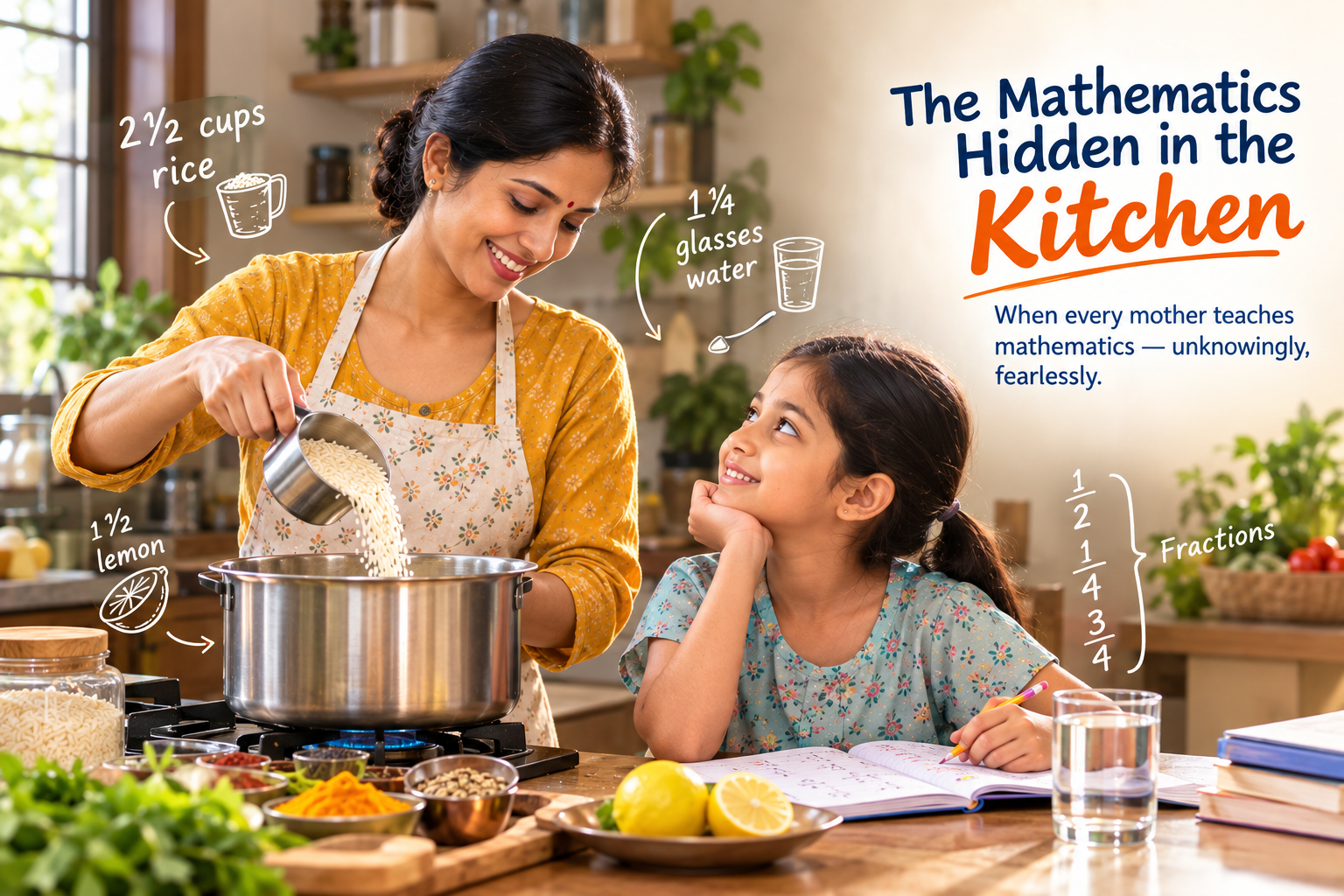
When every mother teaches mathematics; unknowingly, fearlessly
ONE MORNING, ONE KITCHEN
Where Mathematics Is Taught Without a Textbook
It is seven in the morning. The pressure cooker whistles in the kitchen; the second whistle. The aroma of tadka fills the entire house. Heeng (asafoetida), jeera (cumin), and rai (mustard seeds); that familiar blend which is the signature of every Indian morning.
Eight-year-old Priya sits at the kitchen counter. Her maths notebook lies open; fractions homework. 1/2, 1/4, 3/4; these numbers feel like a foreign language to her. She looks up at her mother and says: “Mummy, I just can’t do these fractions.”
Her mother is measuring rice. Without pausing, without thinking, she says: “Put dhai cup chawal (two-and-a-half cups of rice) in that pot.” Priya gets up, takes the measuring cup; two cups, then half a cup. Dhai cup. 2.5 cups. A decimal fraction.
Then her mother says: “Paav chamach haldi (a quarter teaspoon of turmeric).” Priya picks up a teaspoon, estimates a quarter of it; 1/4; and tips it in. Another fraction.
“Dedh gilaas paani (one-and-a-half glasses of water).”; 1.5 glasses. A mixed number. “Aadha neemboo (half a lemon).”; 1/2. A proper fraction.
In ten minutes Priya has used four fractions; without a textbook, without fear, without even knowing she was “doing fractions.”
This is the paradox; and it plays out in every Indian home, every morning, every evening. Millions of mothers say “I don’t know Maths”; and those same mothers use fractions, estimation, proportional reasoning, measurement, and algorithmic thinking every single day. In the kitchen.
This essay is about that hidden mathematics. The mathematics that is taught in every kitchen, every day; without a syllabus, without an exam, without anxiety. And what research tells us about this “unknowing education.”
• • •
THE KITCHEN MATHEMATICS NOBODY TAUGHT
When School and Kitchen Become Two Different Worlds
In 1985, in the city of Recife, Brazil, three researchers; Terezinha Nunes, Analucia Schliemann, and David Carraher; conducted a study that shook the world of mathematics education. They tested the arithmetic of street vendors aged 9 to 15; children who sold fruits and vegetables; using two different methods.
The first method: in the market, posing as real customers. “How much for four bananas? If I take ten bananas, then?” The second method: on paper, the same questions in mathematical form. “4 x 35 = ?” “10 x 35 = ?”
The results were startling: 98% correct in the market. 37% correct on paper. The same children, the same numbers, the same mathematics; but when the context changed, everything changed.
This study became one of the most celebrated proofs of “situated cognition.” Jean Lave, in her 1988 book Cognition in Practice, extended this very principle: mathematics is not an abstract, context-free skill; it works best where it has meaning.
In the Indian context, this same phenomenon can be observed at every sabzi mandi (vegetable market). A vegetable seller who never went to school calculates 250 grams of tomatoes, 750 grams of potatoes, dedh kilo (one-and-a-half kilograms) of onions in seconds; using a blend of mental arithmetic, proportional reasoning, and estimation. The very same mathematics that is considered “difficult” in classes 6–7.
Marta Civil, in her 2002 research, called this divide “everyday mathematics vs. school mathematics.” She showed that in every culture, in every family, there exists a rich treasury of mathematics; one that the family does not recognise as “mathematics,” and the school does not recognise as “mathematics.” It is overlooked from both sides.
Gonzalez, Moll, and Amanti (2005) framed this as the “Funds of Knowledge” theory; every family possesses a body of knowledge accumulated over generations. In the kitchen, this body of knowledge is especially rich; fractions, measurement, estimation, proportional reasoning, time management, and sequential logic, all together, every day, without any formal instruction.
• • •
FRACTIONS
Aadha, Paav, Dhai: Numbers We Speak Every Day But Never Recognize
Recipe Card 1: Fractions
- Ingredients:
- Decimal fractions: 2.5, 1.5, 0.25
- Proper fractions: 1/2, 1/4, 3/4
- Mixed numbers: dhai (2½), dedh (1½), sawa (1¼)
- Hindi fraction vocabulary: aadha (half), paav (quarter), tihaai (third), chauthaai (quarter), sawa (one-and-a-quarter), dhai (two-and-a-half), saadhe (and-a-half)
- Method:
- “Dhai cup chawal (two-and-a-half cups of rice)”; the child counts two full cups + one half cup with a measuring cup. This is 2 + 1/2 = 2.5; decimal and fraction, simultaneously.
- “Paav chamach haldi (quarter teaspoon of turmeric)”; one-quarter of a teaspoon, 1/4 = 0.25. The child estimates it instinctively.
- “Dedh gilaas paani (one-and-a-half glasses of water)”; 1 + 1/2 = 1.5. Mixed number to decimal conversion, daily.
- “Aadha neemboo (half a lemon)”; 1/2, the most fundamental fraction, learned first in the kitchen, not in a textbook.
- Recipe doubling: “This recipe serves 4, we need it for 8”; every fraction doubles → the concept of equivalent fractions.
- Research Evidence: Civil, M. (2002): In everyday mathematics contexts (like the kitchen), children understand fractions naturally because they are ‘meaningful’; not abstract symbols, but real quantities.
Gonzalez et al. (2005): The Funds of Knowledge framework; the family kitchen is the richest source of fraction knowledge, one that formal education overlooks. Empson & Levi (2011): Children learn fractions most easily through sharing and partitioning situations; ‘divide four rotis among three people’; this happens at every Indian meal.
The Hindi language has an extraordinarily rich vocabulary for fractions. In English we say “half, quarter, three-quarters”; and that is about it. In Hindi there is aadha (half), paav (quarter), tihaai (a third), pauna (three-quarters), sawa (one-and-a-quarter), dedh (one-and-a-half), dhai (two-and-a-half), saadhe teen (three-and-a-half), saadhe chaar (four-and-a-half); every fraction has its own name. This linguistic richness shows just how deeply fractions are embedded in Indian daily life.
The ASER 2022 report tells us that 57% of Class 5 children cannot do division. Yet these same children, at home, can easily “break a roti into four equal parts”; division by 4; without any difficulty. The problem is not with mathematics; the problem is with the language of mathematics.
Dadi’s Wisdom
“Add roughly half; then see, if it’s less, add a little more”
This wisdom from Dadi (grandmother) is the oldest method of teaching fractions. Start with “aadha” (1/2). Then “do we need more or not”; that is comparison. “A little more”; that is addition of fractions. “Enough, that’s right”; that is estimation.
Modern research: Siegler et al. (2011) showed that fraction understanding is the strongest predictor of children’s long-term mathematical achievement; stronger even than whole number arithmetic. Children who understand fractions well also perform better in algebra, geometry, and higher mathematics.
Dadi strengthened this very predictor without knowing it; every day, in every recipe.
• • •
ESTIMATION
The Science of Approximation: The Skill No Textbook Teaches, But Every Kitchen Does
Recipe Card 2: Estimation
- Ingredients:
- Approximation: “roughly this much”
- Adjustment: “a little more... that’s it”
- Comparison: “a bit less than yesterday”
- Number sense: “that’s too much”; magnitude judgement
- Method:
- “Andaaze se namak daalo (add salt by estimation)”; the child takes salt in their palm, estimates, adds it, tastes, adjusts. This is iterative estimation.
- “Chutki bhar heeng (a pinch of asafoetida)”; a non-standard measurement based entirely on estimation. Every “pinch” is different, yet each is “roughly right.”
- “Check if the oil is hot enough”; visual estimation of temperature. The child observes the surface of the oil, the smoke, the shimmer, and makes a judgement.
- “Have the rice expanded?”; volume estimation. Raw rice versus cooked rice; observing the change in volume.
- “It’ll be ready in 10 minutes”; time estimation. Then check, adjust, learn; better estimate next time.
- Research Evidence: Siegler & Booth (2004): Estimation ability is the foundation of mathematics learning. Children who are good at number line estimation also perform better in arithmetic. Singapore and Japan’s national curricula explicitly teach estimation; every Indian mother does this naturally, yet the Indian curriculum gives estimation no formal priority. Dowker (2005): Estimation accuracy follows a developmental trajectory; it improves with practice. The kitchen is the most natural environment for daily practice.
Estimation is perhaps the most important and most neglected skill in mathematics. Jordan Ellenberg wrote in his book How Not to Be Wrong: “The power of mathematics is not in exact answers, but in knowing roughly where the truth lies.” That is estimation; knowing approximately where the truth will be.
The Indian kitchen is a laboratory for estimation. When a mother says “andaaze se” (by estimation), she is teaching her child a skill that:
- In Engineering is called “order of magnitude estimation”
- In Physics is called “Fermi estimation” (Enrico Fermi was celebrated for this very skill)
- In Business is called “back-of-the-envelope calculation”
- In Computer Science is called “heuristic approximation”
A child understands fractions in the kitchen but not in the classroom; is the problem in the child or the classroom?
And it all begins with “andaaze se namak daalo”; add salt by estimation.
A child understands fractions in the kitchen but not in the classroom; is the problem in the child or the classroom? The child who learns to add salt ‘by estimation’ in the kitchen is actually learning Fermi estimation the very skill NASA engineers use.
• • •
PROPORTIONAL REASONING
“Four More Have Arrived”: Ratio and Proportion; A Gift from the Indian Joint Family
Recipe Card 3: Proportional Reasoning
- Ingredients:
- Ratio: rice : water = 1 : 2
- Proportion: a recipe for 2 people → scaled up for 8
- Scaling: double, triple, halve | Unit rate: “how much per person”
- Method:
- “The recipe is for two, but eight are eating today”; mother says: “Multiply everything by four.” This is multiplication by a scalar; the very core of proportional reasoning.
- “The rice-to-water ratio: one cup of rice, two cups of water”; this is ratio, a constant of proportionality. Increase the rice and the water must increase in the same proportion.
- “Making chai for 5 cups. One spoon of sugar per cup, so for five cups?”; this is unit rate × quantity = total; direct proportion.
- “We’re making achaar (pickle); 10 kg of mangoes, 1 kg of salt. What if we have 25 kg of mangoes?”; cross-multiplication, proportion solving.
- “Guests arrived unexpectedly; four more mouths to feed”; real-time proportional adjustment, on-the-fly scaling.
- Research Evidence: Lamon (2012): Proportional reasoning is the capstone of elementary arithmetic and the gateway to higher mathematics. It is the ‘bridge’ that connects arithmetic to algebra. Cramer & Post (1993): Children learn proportional reasoning best when the context is meaningful; cooking is one of the most meaningful contexts. Indian context: Joint family meals; where cooking is routinely done for 4 to 15 people; are natural proportional reasoning laboratories. In nuclear families, these opportunities are diminishing.
The Indian joint family; which modernity is dismissing as “outdated”; was the richest natural training ground for proportional reasoning. When food was cooked daily for 10–12 people, every child naturally learned “scaling.” “Dada-Dadi (grandparents) are also here today, make two more rotis”; this is not mere addition, it is proportional adjustment, because the sabzi (vegetables), daal (lentils), and chawal (rice) all need to be increased too.
Lamon (2012), across 25 years of research, established that proportional reasoning is “the most difficult and most important concept in elementary mathematics.” It is taught in classes 6–7 and many children struggle with it. Yet these same children, if they scale recipes in the kitchen, grasp the concept naturally.
Dadi’s Wisdom
“Always remember the rice-water ratio; one part rice, two parts water”
Dadi’s simple rule; “one cup of rice, two cups of water”; is, in truth, a mathematical ratio (1:2), a constant of proportionality. Whether there is one cup of rice or ten, this ratio never changes.
Modern research: Vergnaud (1988) explained proportional reasoning through his “conceptual field” theory; children understand ratio when they can see an invariant relationship (a relationship that does not change). The rice-to-water ratio is precisely such an invariant.
Vergnaud’s theory worked every day in Dadi’s kitchen; without a name.
• • •
MEASUREMENT
Mutthi, Chutki, Angul: Measuring with the Body; The Oldest Method in Mathematics
Recipe Card 4: Measurement
- Ingredients:
- Non-standard units: mutthi (fistful), chutki (pinch), angul (finger-width), balisht (hand-span), haath (arm-length)
- Standard units: cup, teaspoon, grams, litres | Body-based measurement: palm, finger, forearm
- Conservation of quantity: “the vessel changed, the quantity did not”
- Method:
- “Ek mutthi daal (one fistful of lentils)”; every mother’s fist is different, but her own fist is consistent. This is non-standard but reliable measurement.
- “Teen angul adrak (three finger-widths of ginger)”; using the body as a measuring tool. This is exactly what Bruner (1966) calls ‘enactive representation’; learning through the body.
- “Chutki bhar namak (a pinch of salt)”; the amount between thumb and index finger. This ‘pinch’ is used in kitchens around the world.
- “Balisht bhar belan (a hand-span of rolling pin)”; the distance from thumb to little finger. An ancient Indian unit of measurement.
- Non-standard → standard: “One mutthi is roughly 50 grams”; calibration, which children learn naturally.
- Research Evidence: Bruner (1966): Learning proceeds through three stages; enactive (doing), iconic (seeing), symbolic (abstracting). Measurement in the kitchen is the enactive stage; the most essential first step in mathematics education. Singapore Math: The CPA (Concrete-Pictorial-Abstract) approach; first concrete (touching, measuring), then pictorial (drawing), then abstract (numbers). This is exactly what the Indian kitchen does; concrete first. Clements & Sarama (2014): Children learn measurement best when they themselves measure; not through passive observation, but through active participation.
India has a rich heritage of body-based measurement. In the Vedic-era Shulbasutras, the construction of yajna-vedis (sacrificial altars) used measures such as “purusha” (body length), “angul” (finger-width), “pradesha” (thumb to index finger), and “aratni” (elbow to fist). This dates to 800 BCE; and the very same method is alive in every kitchen today.
Why does this matter? Because Singapore, whose mathematics education is considered the best in the world, built its entire pedagogy in 1982 on Jerome Bruner’s principle: first Concrete (touching, doing), then Pictorial (seeing), then Abstract (numbers). The Indian kitchen has been doing this for thousands of years; “first measure with your fist (concrete), then with a cup (standard), then tell me in grams (abstract).” The CPA approach, without knowing its name.
What Singapore adopted in 1982 as a revolutionary approach, Indian grandmothers have been practising in their kitchens for centuries; from concrete to abstract, from body to number.
• • •
TIME & SEQUENCING
When Cooking Becomes an Algorithm: Order and Time; When a Recipe Is a Programme
Recipe Card 5: Time & Sequencing
- Ingredients:
- Sequential logic: first A, then B, then C
- Time estimation: “it’ll be done in 10 minutes”
- Parallel processing: “put the rice on, meanwhile chop the vegetables”
- Conditional logic: “if the oil is hot, then add the jeera (cumin)”
- Method:
- “First heat the oil, then add jeera, then onions”; this is a strict sequence. Change the order and the result changes. This is the very definition of an algorithm.
- “If the onions have turned brown, then add the tomatoes”; a conditional statement (if-then), the basis of programming.
- “While the rice cooks, make the raita”; parallel processing, multitasking, time optimisation.
- “10 minutes for the daal, 20 minutes for the rice, 30 minutes for the roti”; elapsed time, duration calculation, scheduling.
- “Three seeti (whistles) in the pressure cooker”; counting as a timing mechanism, a discrete measurement of a continuous process.
- Research Evidence: Lave (1988): Cooking is one of the most algorithm-rich everyday activities; every recipe is a procedure with inputs, steps, conditions, and outputs. Wing (2006): Computational thinking; which includes sequencing, decomposition, pattern recognition, and abstraction; is naturally embedded in cooking. Rogoff (2003): Children learn best through ‘guided participation’; cooking with a parent in the kitchen is the finest example of guided participation.
In Computer Science, the word “algorithm” comes from the name of the 9th-century mathematician Al-Khwarizmi. But algorithms; step-by-step procedures with clear inputs and outputs; have been running in every kitchen for thousands of years. Every recipe is an algorithm:
Input: ingredients. Process: steps in order. Conditions: “If X happens, then do Y” (if-then statements). Output: the finished dish. Error handling: “too much salt? Add a little flour or a potato” (debugging).
Jeannette Wing (2006) introduced the concept of “computational thinking”; the mode of reasoning that computer scientists use, but which is useful for everyone. Its four pillars are: decomposition (breaking a problem into smaller parts), pattern recognition (identifying patterns), abstraction (extracting the essence), and algorithmic thinking (sequential reasoning). All four happen in the kitchen every day.
Dadi’s Wisdom
“First prepare everything, then light the stove; do it backwards and you’ll burn things”
Dadi’s rule is, in essence, “mise en place”; the French culinary tradition of having all ingredients ready before you begin. But it is also “planning before execution”; a fundamental principle of software engineering.
Modern research: Studies on executive function (Zelazo et al., 2013) show that planning, sequencing, and task-switching; which happen in the kitchen every day; strengthen children’s prefrontal cortex. These same executive functions are the strongest predictors of success in mathematics, science, and academics.
When Dadi said “first prepare everything”; she was training the child’s prefrontal cortex.
• • •
PATTERN RECOGNITION
From Rangoli to the Daily Menu: A World of Patterns; In Art, In Food, In Life
Recipe Card 6: Pattern Recognition
- Ingredients:
- Temporal patterns: Monday chole (chickpeas), Tuesday rajma (kidney beans), Wednesday paneer
- Spatial patterns: rangoli, kolam, alpana
- Culinary patterns: the sequence of tadka; oil, jeera, heeng, onion
- Nutritional patterns: the daily cycle of daal-chawal-sabzi-roti (lentils-rice-vegetables-bread)
- Method:
- “Monday aloo (potatoes), Tuesday paneer (cottage cheese), Wednesday chole”; a weekly recurring pattern. The child predicts: “Today is Wednesday, so it’ll be chole”; pattern-based prediction.
- Daal-chawal every day; repetition, the most fundamental pattern.
- The sequence of tadka is always the same: oil → jeera → heeng → onion → tomato → masala → sabzi. This is a fixed sequence pattern; learn it once, apply it to every sabzi. This is generalisation.
- Seasonal patterns: cool foods in summer (lassi, raita), warm foods in winter (gajar halwa, soup); seasonal pattern recognition.
- Rangoli/Kolam: geometric symmetry, reflection, rotation; these are all mathematical transformations that have been taught as art for generations.
- Research Evidence: Ascher (2002): South Indian kolam traditions contain sophisticated mathematical structures; Euler paths (every line traversed once), graph theory, and rotational symmetry.
These are formal mathematics embedded in a cultural art form. Papic, Mulligan & Mitchelmore (2011): Pattern awareness in early childhood is the strongest predictor of later mathematical thinking; stronger than counting ability. Srinivasan (2004): Indian rangoli traditions; mathematical structures hidden in cultural practice, passed through generations of women who were never formally taught mathematics.
The kolam tradition of South India is a remarkable example of mathematics. Every morning, millions of women draw kolam patterns in their courtyards using rice flour. These kolam are beautiful art; but from a mathematical perspective they are demonstrations of Euler paths (a single line passing through every point once), graph theory, rotational symmetry, and fractal patterns.
Marcia Ascher (2002), in her book Mathematics Elsewhere, called the South Indian kolam “one of the most sophisticated examples of mathematical thinking in everyday life.” These mathematical structures are created and taught by women who never received formal mathematics education; generation after generation, mother to daughter, grandmother to granddaughter.
In North India there is rangoli, in Bengal there is alpana, in Rajasthan there is maandana; every region has its own tradition of geometric pattern-making. All of them teach symmetry, reflection, rotation, and tessellation; the very concepts taught as “geometry” in classes 6–8.
“The grandmothers who draw kolam have never heard of an ‘Euler path’; yet they create Euler paths every morning. There is a difference between knowing mathematics and doing mathematics.”
— Marcia Ascher, Mathematics Elsewhere, 2002
• • •
THE DEEPER SCIENCE
Cognition in Practice: Why Mathematics Feels ‘Easy’ in the Kitchen and ‘Hard’ in the Classroom
So far we have seen that fractions, estimation, proportional reasoning, measurement, algorithmic thinking, and pattern recognition all happen in the kitchen. But a deeper question remains: why does the same mathematics feel “easy” in the kitchen and “hard” in the classroom?
Jean Lave (1988) offered the answer: situated cognition. Mathematics is not a “portable skill” that automatically transfers from one context to another. Mathematics works best in a situation where both its purpose and its meaning are clear.
In the kitchen, mathematics is meaningful: “dhai cup chawal” (two-and-a-half cups of rice) matters because too little means people go hungry, too much means waste. The feedback for errors is immediate and sensory; too much salt and the food tastes salty. And most importantly: mistakes are fixable; “add a little flour, it’ll be fine.”
In the classroom, mathematics feels meaningless: “1/2 + 1/4 = ?”; why add them? What for? The feedback for errors is a red cross (x); “wrong.” And mistakes feel permanent; “marks deducted,” “rank dropped,” “scolding received.” The difference comes down to: purpose, feedback, and error tolerance.
Boaler (2016) showed in her research that when mathematics is taught in meaningful contexts; real-world problems, projects, investigations; children’s performance improves by 40–50% and math anxiety reduces significantly. The kitchen is precisely such a meaningful context; perhaps the most natural one.
Three Reasons: Kitchen Versus Classroom
First; Purpose: In the kitchen, mathematics exists because food needs to be cooked. In the classroom, mathematics exists because “it is in the syllabus.” When the purpose is clear, motivation is intrinsic.
Second; Feedback: In the kitchen, feedback is immediate, sensory, and informative; “too salty,” “well made,” “cook a little more.” In the classroom, feedback is delayed, symbolic (✓ or ✗), and often uninformative; it tells you “wrong” but not “why wrong.”
Third; Error Tolerance: In the kitchen, a mistake = a chance to learn. “Too much salt? Never mind, use less next time.” In the classroom, a mistake = punishment. “Marks cut,” “rank dropped,” “scolded.” When there is no room for error, the child simply stops trying. And without trying, no one can learn mathematics.
• • •
INDIAN DATA
The Depth of the Paradox: When the Numbers Tell a Different Story
Some data points that sharpen this paradox:
- ASER 2022: Only 25.6% of Class 3 children can do two-digit subtraction. Yet ask these same children “You had 10 rupees and bought something for 7; how many are left?” and many will answer correctly. Change the context, change the performance.
- National Achievement Survey (NAS) 2021: The national average score for mathematics in Class 3 is 306/500; approximately 60%. But this score measures procedural knowledge (knowing the method), not conceptual understanding (grasping the idea).
- Cuemath (2022): 82% of Indian children (ages 6–16) report math anxiety. But do these same children fear mathematics in their own kitchen? No. Because there, they do not even know they are “doing mathematics.”
An estimate: if an average Indian mother cooks twice a day, she performs at least 15–20 mathematical operations daily; measurement, estimation, proportional adjustment, time calculation, sequential planning. That is 450–600 per month. 5,000–7,000 per year. Over twenty years, more than 100,000. And this is the same mother who says: “I don’t know Maths.”
• • •
WHAT PARENTS CAN DO
10 Kitchen Activities: Start Today; No Preparation Needed
All of this is wonderful to know; but “what should we actually do?” is the most important question. Here are ten concrete activities you can start today:
- This week, cook one recipe with your child. Any recipe; chai (tea), Maggi (instant noodles), salad, daal (lentils), anything. Just one condition: the child does the measuring, you tell them how much.
- Say “dhai cup” (two-and-a-half cups); let the child count it out. Two cups + half a cup. Don’t say “this is a fraction”; just let them do it.
- Ask: “If two more people come, how much more will we need?”; proportional reasoning, without a textbook.
- Make the child the “kitchen calculator”: “We need 6 rotis today, each takes 50 grams of flour; how much flour in total?”; multiplication in context.
- While making chai: “5 cups of chai, one spoon of sugar per cup, but two cups need only half a spoon (diabetes); how many spoons in total?”; addition with fractions.
- “Guess how many biscuits are in this tin”; an estimation game. Then count, check, and make a better estimate next time.
- Make a rangoli together; “make this design the same on this side too”; symmetry. “Now make it rotated”; rotation.
- Have the child plan the weekly menu: “7 days, 7 vegetables; no repeats”; combinatorics, planning, constraint satisfaction.
- Set a timer: “5 minutes for the onions to brown, 10 minutes for the sabzi to cook, when should we start the rotis so everything is ready together?”; scheduling, elapsed time.
- Most important: when the child does something right in the kitchen; say “Wow, you measured that perfectly!” Celebrate the mathematical success; without using the word “Maths.” Recognition builds confidence.
The child who divides ₹2 among 3 toffees knows division; so how does he fail the exam?
Dadi’s Wisdom
“Let the children come into the kitchen; they will learn, not make a mess”
In many homes, children are kept away from the kitchen; “it’s dangerous,” “you’ll make a mess,” “get out of the way.” Safety matters, but complete exclusion deprives the child of an extraordinary learning environment.
Rogoff (2003) found that children learn through “legitimate peripheral participation”; first by watching, then by doing small tasks, then larger ones. The kitchen is the perfect example: first the child watches, then washes vegetables, then chops, then measures, then cooks on their own.
Dadi knew: including a child in the kitchen is teaching them. Keeping them out is keeping them from learning.
• • •
TODAY’S EXPERIMENT
Kitchen Math Challenge: One Evening, One Recipe, One Child
Today’s Experiment: Kitchen Math Challenge
This evening, invite your child into the kitchen.
Give them any recipe; chai, Maggi, salad, parantha, anything.
Just one condition: the child measures, you tell them how much.
Say “dhai cup chawal” (two-and-a-half cups of rice); let the child count.
Say “paav chamach haldi” (quarter teaspoon of turmeric); let the child estimate.
Say “dedh gilaas paani” (one-and-a-half glasses of water); let the child measure.
If they make a mistake; that’s fine. “Add a little more” or “a little less”; that’s all.
Never say: “This is a fraction” or “This is Maths.”
Just let them do it. Just enjoy it. Just cook together.
And when the food is ready; tell the child: “Today you did Maths without a book. Dhai = 2.5, paav = 1/4, dedh = 1.5. These are all fractions; and you did them without fear.”
The sparkle in the child’s eyes; no textbook can produce that.
• • •
A GLOBAL PERSPECTIVE
What the World Is Doing: When Other Countries Connected the Kitchen to the Classroom
Several countries have made “everyday mathematics” a formal part of their curriculum:
- Japan: The Japanese elementary mathematics curriculum includes “real-life problem solving” as a formal component. Children learn mathematics through grocery shopping, cooking, and household budgeting. Japan consistently ranks in the top 5 in TIMSS (Trends in International Mathematics and Science Study).
- Singapore: The CPA (Concrete-Pictorial-Abstract) approach; based on Bruner’s theory; is the foundation of Singapore Math. Children first do mathematics with real objects (concrete), then with pictures (pictorial), then with symbols (abstract). The kitchen is the perfect “concrete” environment.
- Finland: The Finnish National Curriculum (2016) explicitly makes “everyday life connections” a mandatory part of mathematics teaching. Teachers must connect every concept to a real-life context. Finland consistently scores high in PISA.
- Netherlands: Realistic Mathematics Education (RME); Hans Freudenthal’s theory; holds that mathematics begins with “reality.” “Mathematics is not a ready-made product, but a human activity”; Freudenthal’s vision is the cornerstone of Dutch mathematics education.
- India: NEP 2020 speaks of “experiential learning” and “connecting learning to real life.” NCF 2023 (National Curriculum Framework) also gives importance to “everyday mathematics.” But implementation; in the classroom, in teacher training, in examination methods; remains a distant goal.
Japan, Singapore, Finland, Netherlands; the world’s most successful mathematics-education nations agree on one thing: mathematics must begin from life and be for life. Every Indian kitchen already does this; it just needs to be recognised.
• • •
DADI'S VISION
2126; A Hundred Years Hence
Dadi’s Wisdom
Dadi’s Vision
Dadi used to say: ‘Put the child to work, they will learn on their own.’ This single sentence is the essence of the 21st century’s most significant educational research; ‘Learning by Doing’ (Dewey, 1938), ‘Situated Cognition’ (Lave, 1988), ‘Funds of Knowledge’ (González, 2005). Dadi did not need research. She knew what her child needed.
Every Indian home will recognise itself as a ‘learning lab.’ Parents will receive government-supported training; ‘Where is mathematics hidden in your home?’ The wall between school and home will grow thinner. NEP 2020’s vision of ‘experiential learning’ will become reality.
The distinction between ‘school’ and ‘not-school’ will have dissolved. Learning will happen everywhere; validated, recognised, celebrated. A child’s morning spent in the kitchen will be as valuable as one spent in the classroom. Knowledge will no longer be locked within walled institutions.
Every space a child occupies; the kitchen, the garden, the street, the market; will be a learning space. ‘विद्या ददाति विनयम्’ (Knowledge bestows humility); knowledge will be everywhere, and therefore, so will humility. Education will not happen in a building; education will happen in life.
• • •
CONCLUSION
From the Kitchen to the Classroom: When Home and School Speak the Same Language
This essay began with a kitchen scene; Priya, who was afraid of fractions, was fearlessly measuring “dhai cup chawal” (two-and-a-half cups of rice).
This is no coincidence. It is situated cognition, it is funds of knowledge, it is meaningful mathematics. It shows that the fear of mathematics lies not in mathematics itself, but in how mathematics is presented. When the presentation changes; from textbook to kitchen, from symbol to action, from exam to experience; the fear vanishes.
Every Indian kitchen is a mathematics laboratory. Every mother is a mathematics teacher; even if she does not see herself that way. Every recipe is a lesson plan. Every meal is a maths class.
This does not mean school is unnecessary; school is essential. Formal mathematics education teaches abstract thinking, proof, and generalisation that the kitchen alone cannot. But it does mean that school should learn from the kitchen; about purpose, feedback, and error tolerance.
And parents should know this: “I don’t know Maths”; that is not true. You do Maths every single day. Your kitchen is full of Maths. Your child can learn Maths from you; without a textbook, without tuition, without anxiety. Just invite them into the kitchen.
Mathematics in the kitchen happens without fear; because mistakes are allowed. Too much salt? Let’s fix it. The next essay is about that very freedom to make mistakes; in the classroom, in examinations, and throughout a child’s entire educational journey. Because until mistakes are allowed, learning will not happen.
Mathematics lives in our lives. The question is; who will bring it from life into the classroom?
If mathematics happens in every home every day; without books, without fear; then why do we need a separate ‘maths period’?
Innovation in Education; For Every Child, From Every Home
• • •
REFERENCES & CITATIONS
References
- Nunes, T., Schliemann, A.D. & Carraher, D.W. (1993). Street Mathematics and School Mathematics. Cambridge University Press. Brazilian street vendors study: 98% accuracy in market vs 37% on paper.
- Lave, J. (1988). Cognition in Practice: Mind, Mathematics and Culture in Everyday Life. Cambridge University Press. Situated cognition and everyday mathematical practice.
- Civil, M. (2002). “Everyday Mathematics, Mathematicians’ Mathematics, and School Mathematics: Can We Bring Them Together?” Journal for Research in Mathematics Education, Monograph 11, 40-62.
- Gonzalez, N., Moll, L.C. & Amanti, C. (2005). Funds of Knowledge: Theorizing Practices in Households, Communities, and Classrooms. Lawrence Erlbaum Associates.
- Empson, S.B. & Levi, L. (2011). Extending Children’s Mathematics: Fractions and Decimals. Heinemann. Children learn fractions through sharing and partitioning situations.
- ASER Centre (2023). Annual Status of Education Report (ASER) 2022. Pratham Education Foundation, New Delhi. 57% of Class 5 children cannot do division.
- Siegler, R.S., Duncan, G.J., Davis-Kean, P.E., Duckworth, K., Claessens, A., Engel, M., Susperreguy, M.I. & Chen, M. (2012). “Early Predictors of High School Mathematics Achievement.” Psychological Science, 23(7), 691-697.
- Siegler, R.S. & Booth, J.L. (2004). “Development of Numerical Estimation in Young Children.” Child Development, 75(2), 428-444.
- Leung, F.K.S. & Li, Y. (Eds.) (2010). Reforms and Issues in School Mathematics in East Asia. Sense Publishers. Singapore CPA approach, Japan and Finland curriculum analysis.
- Dowker, A. (2005). Individual Differences in Arithmetic: Implications for Psychology, Neuroscience and Education. Psychology Press.
- Ellenberg, J. (2014). How Not to Be Wrong: The Power of Mathematical Thinking. Penguin Press.
- Lamon, S.J. (2012). Teaching Fractions and Ratios for Understanding: Essential Content Knowledge and Instructional Strategies for Teachers (3rd ed.). Routledge. Proportional reasoning as gateway to higher mathematics.
- Cramer, K. & Post, T. (1993). “Proportional Reasoning.” Mathematics Teacher, 86(5), 404-407. Meaningful contexts improve proportional reasoning.
- Vergnaud, G. (1988). “Multiplicative Structures.” In J. Hiebert & M. Behr (Eds.), Number Concepts and Operations in the Middle Grades. NCTM. Conceptual field theory and proportional reasoning.
- Bruner, J.S. (1966). Toward a Theory of Instruction. Harvard University Press. Enactive, iconic, and symbolic stages of learning.
- Clements, D.H. & Sarama, J. (2014). Learning and Teaching Early Math: The Learning Trajectories Approach (2nd ed.). Routledge. Active measurement learning.
- Plofker, K. (2009). Mathematics in India. Princeton University Press. Shulbasutras and body-based measurement in Vedic tradition.
- Wing, J.M. (2006). “Computational Thinking.” Communications of the ACM, 49(3), 33-35.
- Rogoff, B. (2003). The Cultural Nature of Human Development. Oxford University Press. Guided participation and legitimate peripheral participation.
- Zelazo, P.D., Blair, C.B. & Willoughby, M.T. (2016). Executive Function: Implications for Education. NCER, IES, U.S. Department of Education. Executive function and academic achievement.
- Ascher, M. (2002). Mathematics Elsewhere: An Exploration of Ideas Across Cultures. Princeton University Press. South Indian kolam as mathematical structures; Euler paths, graph theory, symmetry.
- Papic, M.M., Mulligan, J.T. & Mitchelmore, M.C. (2011). “Assessing the Development of Preschoolers’ Mathematical Patterning.” Journal for Research in Mathematics Education, 42(3), 237-268.
- Srinivasan, S. (2004). “Kolam: A Mathematical Treasure of South India.” Resonance, 9(11), 63-68. Indian Institute of Science.
- Boaler, J. (2016). Mathematical Mindsets: Unleashing Students’ Potential through Creative Math, Inspiring Messages and Innovative Teaching. Jossey-Bass. Meaningful contexts improve performance by 40-50%.
- NCERT (2022). National Achievement Survey (NAS) 2021. National Council of Educational Research and Training, New Delhi.
- Cuemath (2022). “Global Math Anxiety Report.” Cuemath Research, Bengaluru. 82% of Indian children aged 6-16 report math anxiety.
- Freudenthal, H. (1991). Revisiting Mathematics Education: China Lectures. Kluwer Academic Publishers. Realistic Mathematics Education (RME).
- UNESCO. (2015). Education 2030: Incheon Declaration and Framework for Action.
- OECD. (2019). OECD Future of Education and Skills 2030: Conceptual Learning Framework; Student Agency.
- Kalam, A.P.J. Abdul. (2002). Ignited Minds: Unleashing the Power Within India.
- Dewey, J. (1938). Experience and Education. New York: Macmillan.