10 Bharatiya principles of a Growth Mindset to guide your journey towards personal development and success
10 Bharatiya principles of a Growth Mindset to guide your journey towards personal development and success
- May 07, 2026
- Manish Manjul
Alive for thousands of years, and just as relevant today - Manish Manjul, Founder-General Secretary, Samarth Trust
In 2006, Stanford University professor Carol Dweck wrote a book, “Mindset: The New Psychology of Success.” She explained that human beings think in two ways: one, “I am what I am, I cannot change” (Fixed Mindset), and the other, “I can learn, I can change” (Growth Mindset).
The world hailed it as a revolutionary discovery. Schools organised workshops. Companies ran training sessions. TED Talks went viral.
But when we in Bharat read this, a strange feeling arises; this is exactly what our grandparents always said. “Work hard, don’t worry about the result.” “If you fall, get up.” “With practice, everything becomes possible.”
And when we go deeper, into the Gita, the Upanishads, the Yoga Sutras, Shankaracharya, we realise that what Dweck said in 2006, the Bhartiya rishis had not only said thousands of years ago but had lived it.
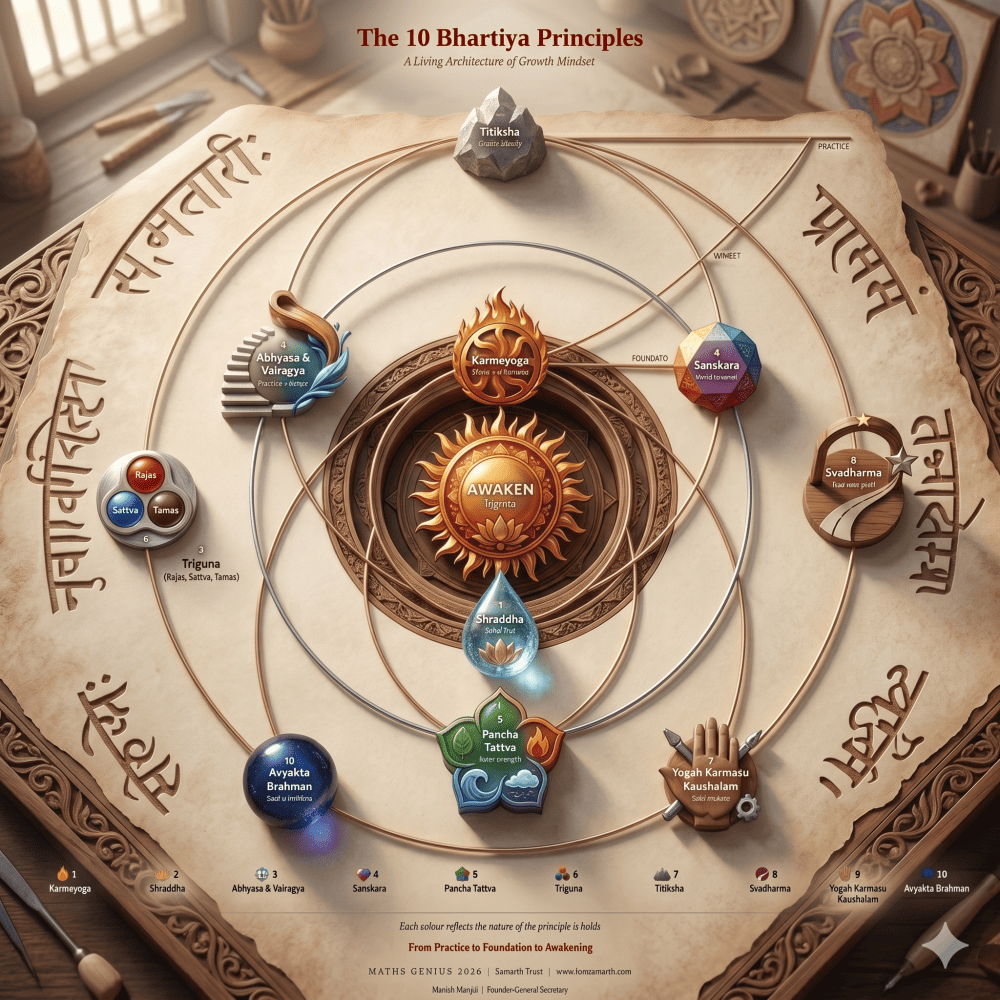
This article presents the 10 Bhartiya principles that form the foundation of Growth Mindset, remain just as relevant today, and no one has been able to disprove.
Not “Learning,” Not “Growing” – “Awakening”
Before we explore the 10 principles, a fundamental question: What is the right word for “Growth Mindset”?
Western psychology calls it a “Learning Mindset”, a mind that learns. The underlying assumption: the child is an empty vessel; pour knowledge in from outside, and it fills up. This is a teacher-centred view; knowledge exists outside, not within the child.
Some prefer “Growing Mindset”, a mind that grows. This is better; there is development, there is progress. But “growing” still implies outward expansion: a tree grows taller, numbers grow larger, output grows bigger.
Bhartiya philosophy says something altogether different.
Swami Vivekananda declared, “Education is the manifestation of the perfection already in man.” Note carefully: not “learning,” not “growing”, it is “manifesting.” The child is not an empty vessel; the child is already full; the lid is simply closed. The teacher’s task is not to fill, but to open.
The Chandogya Upanishad proclaims, “Tat Tvam Asi”; You are That. The knowledge that pervades the universe already resides within the child. There is nothing to learn; there is only awakening. Remembering. Manifesting.
So the correct word is:
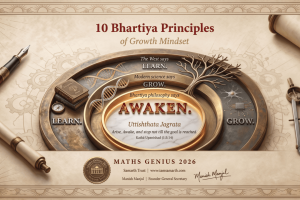
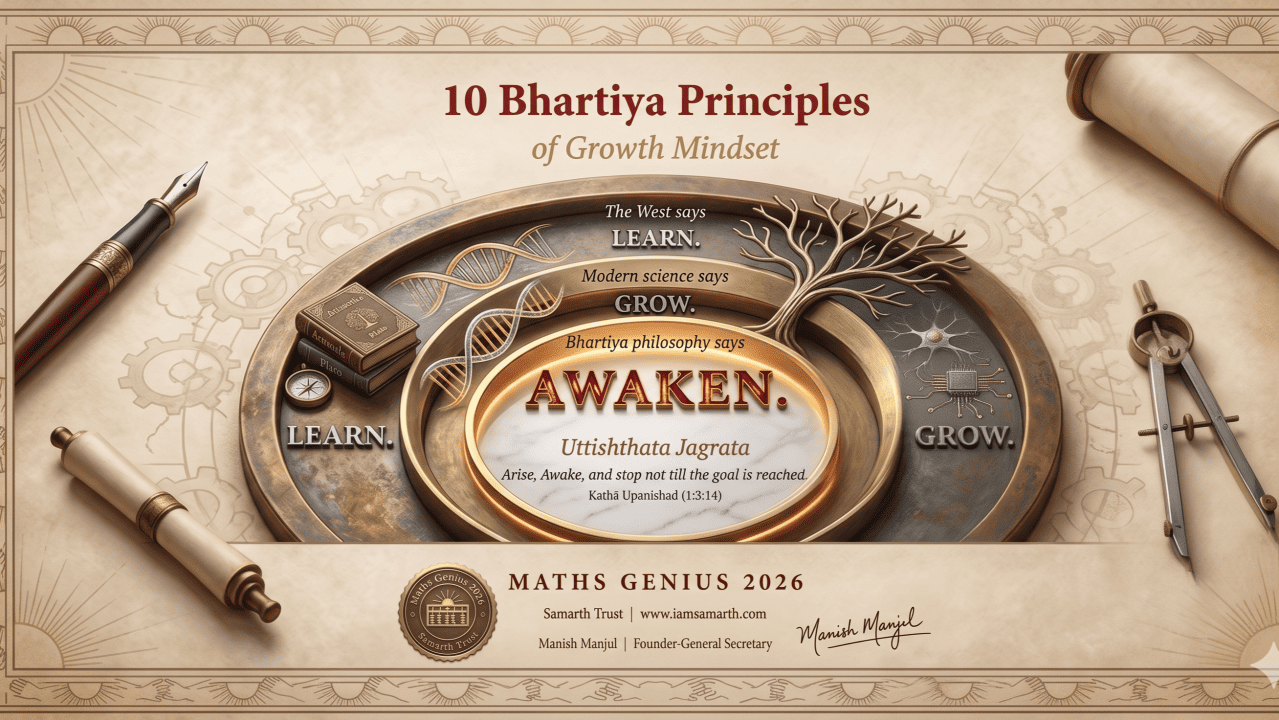
The West says — “Learn” — knowledge comes from outside.
Modern science says — “Grow” — capacity develops over time.
Bhartiya philosophy says — “Awaken” — knowledge is already within; manifest it.
“Uttishthata Jagrata Prapya Varannibodhata”: Arise, Awake, and stop not till the goal is reached.
— Katha Upanishad (1.3.14)
Dweck says, “The child has potential; develop it.” Bharat says, “The child already contains perfection; awaken it.” This is not a difference of words; it is a difference of vision. And this vision is the foundation of these 10 principles.
1. Focus on Effort, Not Outcome
कर्मण्येवाधिकारस्ते मा फलेषु कदाचन।
Karmanyevadhikaraste ma phaleshu kadachana
Your right is to action alone, never to its fruits
Shrimad Bhagavad Gita (2.47)
A child cries before an exam, “What if I fail?” Another child thinks, “I just need to give my best effort; whatever happens, we’ll see.” The first child is focused on the result. The second, on the effort.
This is the very difference between Fixed and Growth Mindset, and it is the most celebrated teaching of the Gita.
Shri Krishna did not tell Arjuna on the battlefield to “win.” He said, “Fight. Fight with all your might. But let go of concern about victory or defeat.” Why? Because the one who worries about the outcome becomes afraid. The one who is afraid does not give full effort. And the one who does not give full effort can never discover the true extent of their ability.
The essence of Dweck’s research is precisely this, process-oriented children perform better than result-oriented children. The Gita said this thousands of years ago.
Maharishi Jaimini’s Mimamsa philosophy simplified it further, action is everything. Stop wondering “will it happen or won’t it”, just do it. The answer lies within the action itself.
2. Shraddha – “First Believe That You Can Learn”
श्रद्धावान् लभते ज्ञानम्
Shraddhavan labhate jnanam
Only one with shraddha (faith) attains knowledge.
Shrimad Bhagavad Gita (4.39)
You will make an effort only when you believe that the effort will bear fruit. If a child has already decided that “maths is not for me”, why would they even try?
The Gita calls this “shraddha.” And its warning is stark, “Samshayatma vinashyati”, the one who is paralysed by doubt is destroyed. Neither in this world nor the next does such a person find happiness.
But shraddha is not merely self-confidence. It operates on three levels: belief in one’s own capacity (“I can learn”), belief in one’s path (“this method is right”), and belief in one’s teacher (“the one teaching me knows what they are doing”). When all three levels converge, knowledge dawns.
Shankaracharya called this “mumukshutva”, an intense thirst to know, to learn. This is the deepest form of shraddha, when the hunger for knowledge is so fierce that one cannot rest without it. This is the gateway to Growth Mindset, first shraddha, then everything else follows.
3. Abhyasa and Vairagya – The Twin Pillars of Growth
अभ्यासेन तु कौन्तेय वैराग्येण च गृह्यते
Abhyasena tu Kaunteya vairagyena cha grihyate
Through practice and detachment, the mind is mastered.
Shrimad Bhagavad Gita (6.35)
There is a remarkably honest moment in the Gita. Arjuna says, “Krishna, controlling the mind is as difficult as stopping the wind!” And Krishna smiles and replies, “Yes, it is difficult. But not impossible. Two things make it possible, abhyasa (practice) and vairagya (detachment).”
Abhyasa is easy enough to understand; do it again and again and again. What is not possible today will be possible tomorrow. What won’t happen tomorrow will happen the day after. But keep at it.
Vairagya is less well understood, and it is the deepest key to the Growth Mindset. Vairagya means: practise, but do not become enslaved by the result. Today you solved 3 out of 10 problems, that’s fine. Tomorrow it will be 4. But stop lamenting that “today it was only 3.” It is precisely this detachment from outcomes that makes practice sustainable, a child gives up within two days.
Shankaracharya deepened this concept of vairagya further; his vairagya is detachment from the fruits of both this world and the next. No anxiety about marks, no obsession with winning competitions. Only the discipline of understanding.
4. Sanskara – “Practice Actually Rewires the Mind”
Here, science and philosophy converge — and philosophy arrived thousands of years earlier.
Bhartiya philosophy teaches that every action leaves an imprint, a “sanskara”, on the mind. When a child repeatedly thinks “I can’t do this,” that thought carves a deep groove; a vasana (tendency). And then, with every new challenge, that same old groove replays: “See, I can’t do it.”
But this is the most important insight: old sanskaras can be erased. How? With new sanskaras. When that same child repeatedly thinks “I am learning,” repeatedly practises, and repeatedly experiences small successes, a new groove is carved. And gradually, the old groove fades.
In the 2000s, neuroscience demonstrated, using brain scans, that repeated practice strengthens existing neural pathways and creates new ones. They named it “neuroplasticity.” The world hailed it as a breakthrough discovery.
But Bhartiya philosophy had articulated this very insight through the “Sanskara theory” thousands of years earlier, without brain scans, through observation and lived experience alone. To say it didn’t exist because it wasn’t written on paper is like saying sunrises didn’t happen before the camera was invented.
5. Pancha Tattva and Inner Strength – “Nothing Comes to the Weak”
नायमात्मा बलहीनेन लभ्यो
Nayamatma balahinena labhyo
The Self cannot be attained by the weak.
Mundaka Upanishad (3.2.4)
A harsh statement, but true. The Upanishad declares that nothing is attained by the weak. Not knowledge, not growth, not the Self. But “strength” here does not mean physical power; it means inner strength.
And where does this inner strength come from? From the balance of the Pancha Tattva (Five Elements):
Prithvi (Earth) = Patience – Just as the earth bears everything, growth requires patience. A child who demands results in one week will never learn deeply.
Jala (Water) = Adaptability – Water takes the shape of every vessel. A child who cannot learn one way must try another way, flow, don’t freeze.
Agni (Fire) = Tapas (Inner Fire) – Nothing cooks without fire. Without tapas (inner motivation), there is no growth. It cannot come from outside; it must burn from within.
Vayu (Air) = Persistence – The wind never stops. It keeps moving. Practice must be the same, never stop, keep going.
Akasha (Space) = Limitless Possibility – Space has no boundary. And the potential of every child has no boundary either. “I can only do this much”, that is the absence of the Akasha element.
The Taittiriya Upanishad’s Pancha Kosha theory teaches that growth must happen not just at the level of the mind, but across five sheaths: body (Annamaya), energy (Pranamaya), mind (Manomaya), intellect (Vijnanamaya), and spirit (Anandamaya). Dweck works on only the Manomaya kosha, a single level. Bhartiya philosophy addresses all five.
6. Triguna Theory — Mindset Changes
Three children sit in a classroom. The teacher poses a difficult problem.
The first child says, “Forget it, I can’t do this.” He closes his notebook.
The second child says, “I have to do it, or I’ll lose marks.” He scribbles something quickly.
The third child says, “Wait, this is interesting, let me think.” She thinks, makes a mistake, then thinks again.
In Kapila Muni’s Sankhya philosophy, these three are named:
Tamas: The first child. Inertia, lethargy, “I can’t do this.” This is the deepest form of Fixed Mindset.
Rajas: The second child. There is motivation, there is energy, but it is tied to outcome. Happy when marks come, shattered when they don’t.
Sattva: The third child. Pure curiosity. Understanding for the sake of understanding. This is the true Growth Mindset.
And the most crucial point is that Kapila Muni teaches that these gunas keep shifting. No person is always tamasic, no one is always sattvic. In the morning, there may be tamas, by noon rajas, and by evening sattva. It is a choice, not destiny.
And Patanjali made this choice even easier, “Pratipaksha Bhavana”, when a tamasic thought arises (“I can’t do this”), immediately replace it with its opposite (“I am learning”). That’s it. That’s simple. This is Cognitive Reframing, from 2,000 years ago.
7. Titiksha: “Fall, Rise, Don’t Complain”
Resilience is a very popular word these days: “If you fall, get up.” Every motivational speaker says this.
But Adi Shankaracharya said something far more profound. He gave us a word, Titiksha.
Resilience says: “If you fall, get up.”
Titiksha says, “If you fall, get up, and don’t complain either.”
Understand the difference. In resilience, there is the pain of falling, the struggle of rising, and then the pride of “I did it.” In Titiksha, there is none of that, no display of pain, no drama of struggle, no pride. Just quietly get up and walk. Difficulty ceases to be difficulty; it becomes part of the discipline.
Goswami Tulsidas wrote in the Ramcharitmanas that patience is tested only in adversity. Rama’s 14-year exile, no complaints, no anger, no “why me?” He simply kept walking. That is Titiksha.
Shankaracharya placed titiksha in his “Sadhana Chatushtaya”, four qualifications needed for learning: Viveka (discernment between right and wrong), Vairagya (detachment from results), six inner virtues (of which titiksha is one), and Mumukshutva (the thirst to learn). This is the complete architecture of Growth Mindset. Dweck said, “Change your mindset.” Shankaracharya laid out exactly what preparation is needed for that change.
8. Svadharma: “Don’t Compare, Walk Your Own Path”
स्वधर्मे निधनं श्रेयः परधर्मो भयावहः
Svadharme nidhanam shreyah paradharmo bhayavahah
It is better to perish following one’s own dharma; the dharma of another is fraught with peril.
Shrimad Bhagavad Gita (3.35)
A mother tells her child, “Look at Mr Sharma’s son next door, he scored 95%!” And with that single sentence, the child’s Growth Mindset is destroyed.
Why? Because now the child is walking not at their own pace but at someone else’s. Not on their own path but on someone else’s. The Gita calls this “paradharma”, and declares that paradharma is dangerous.
Every child has their own svadharma, their own pace, their own style, their own strength, their own direction. The child who excels at mathematics has a different svadharma. The one gifted in art has another. The one who learns slowly but deeply has yet another.
Madhvacharya provided the philosophical foundation for this: every soul is unique; no two souls are alike. Therefore, measuring everyone by the same yardstick is an injustice.
And Guru Nanak Dev said it in the simplest possible language: every human being is equal. “Kirat Karo”, do honest work. Your own work, on your own path. Comparison is poison, and this poison is the greatest cause of Fixed Mindset.
9. Yogah Karmasu Kaushalam: “The Development of Skill Is True Yoga”
योगः कर्मसु कौशलम्
Yogah karmasu kaushalam
Excellence in action is yoga.
Shrimad Bhagavad Gita (2.50)
Many people think yoga means postures, meditation, and sitting with eyes closed. But the Gita says, no. Yoga means becoming progressively more skilful at what you do.
A carpenter who builds a better chair each day is a yogi. A child who could solve 3 out of 10 problems yesterday and can solve 5 today is a yogi. A teacher who refines their teaching method every year is a yogi.
The word “kaushalam” (skill) is crucial here. The Gita does not merely say “perform actions”, it says “bring skill to your actions.” Mere repetition is not enough; improve each time. This is Deliberate Practice, not just practice, but thoughtful, purposeful practice aimed at continuous improvement.
What matters is not talent, but skill. Talent is given at birth (Fixed Mindset); skill is developed through practice (Growth Mindset). The Gita explicitly chooses skill.
10.“Each Soul Is Potentially Divine”: Limitless Possibility
“Each soul is potentially divine. The goal is to manifest this divinity within.”
Every soul is unexpressed Brahman. The goal is to manifest this divinity.
Swami Vivekananda
So far, we have seen 9 principles: make the effort, have faith, practise, the mind can be rewired, endure hardship, don’t compare, and develop skill. But the deepest question is this: What is the extent of human possibility? Is there a limit?
The Chandogya Upanishad declares, “Tat Tvam Asi”, You are That. Every child carries the same consciousness that is Brahman. If every child contains Brahman, how can any child be called “weak”?
Swami Vivekananda expressed this in the most powerful language: “Education is the manifestation of the perfection already in man.” Note: not “potential”, “already in man.” The child is not weak; their perfection is simply unexpressed (avyakta). The teacher’s task is not to pour in from outside, but to draw out from within.
Dweck says the child has potential. Vivekananda says, ” Perfection is already present; you just need to lift the lid.
Maharishi Aurobindo took this further: the human being is not the final step of evolution. Consciousness is evolving, from matter to life, from life to mind, from mind to overmind, from overmind to supermind. Growth Mindset, for Aurobindo, is one stage, not the destination.
And Ramana Maharshi asked the simplest question, “Who am I?” When a child says, “I am weak”, Ramana Maharshi asks, “Who is this ‘I’?” When you investigate, you discover that all these labels, weak, smart, failure, pass, are not you. You are beyond all of them. This is Identity-Level Transformation. Dweck changes behaviour; Ramana Maharshi changes identity itself.
“Arise, awake, and stop not till the goal is reached.”
Living Proof: These Principles Are Alive Today
These 10 principles are not mere theory — the people who lived them can be found in every direction of Bharat, in every era. From the Puranic age to the present day, from every state, from every background.
Ancient and Historical Proof: From Every Corner of Bharat:
Valmiki (Ancient Bharat): The journey from the dacoit Ratnakar to the sage Maharishi. The hands that once plundered went on to compose the Ramayana. If a dacoit can write an epic, anyone can change. This is the most powerful proof of transformation.
Eklavya (Mahabharata Era): The guru refused him; the institution shut its door. But he practised alone before a clay idol of the guru, and mastered archery to a level that astonished even the guru himself. This is Self-Regulated Learning, without resources, purely through faith and effort.
Karna (Mahabharata/Hastinapura/North Bharat): Branded a charioteer’s son, society told him, “You cannot do this.” He was humiliated in the arena. But Karna never accepted the Fixed Mindset; through his actions, he earned everything that birth had denied him. Even Shri Krishna praises his generosity.
Sudama (Dwaraka/Gujarat): Poverty did not erase his identity. Neither his learning, nor his friendship, nor his self-respect was diminished. Poverty was a circumstance, not an identity. Devotion and action changed his destiny. This is Identity-Level Resilience.
Shabari (Dandakaranya/Central Bharat): A tribal woman, deemed “untouchable” by society. But she never gave up her faith; she waited for years, gathered berries, and watched for Rama’s arrival. And when Rama came, he accepted her half-eaten berries, because shraddha has no caste or creed.
Vidura (Hastinapura/Uttar Pradesh): Son of a maidservant. Born into the royal family, yet denied the title of prince. But Vidura surpassed everyone in intellect, policy, and wisdom — the “Vidura Niti” is still regarded as a foundational text of political and ethical thought. Birth imposed a limit; knowledge shattered it.
Gargi and Maitreyi (Bihar/Videha): In an age when women’s education was scarcely imaginable, Gargi challenged the sage Yajnavalkya in philosophical debate at the royal court. Maitreyi asked her husband not for wealth, but for knowledge, “Yenaham namrita syam” (that which gives me immortality). This is Growth Mindset, a hunger for knowledge that transcends gender, era, and circumstance.
Kalidasa (Madhya Pradesh/Ujjain): Legend has it that Kalidasa was once an illiterate man, sitting on the very branch he was cutting. After marriage, humiliation awakened him. He then practised with such discipline, such devotion, that he became the greatest poet of Sanskrit literature. “Meghadutam” and “Abhijnanashakuntalam” are treasures of world literature. From ignorance to mastery, this is the journey from tamas to sattva.
Chanakya/Kautilya (Bihar/Pataliputra): A humiliated Brahmin (Teacher). Cast out of the Nanda court. Chanakya untied his shikha and vowed, then took an ordinary boy named Chandragupta and built an entire empire. The “Arthashastra” remains a foundational text of politics and economics to this day. One person’s effort can change the course of history.
Aryabhata (Bihar/Pataliputra): In the 5th century, without any telescope, without a calculator, without a computer, he calculated the circumference of the earth, the distance to the sun, and the motion of the planets. He systematised the concept of zero and the decimal system. Only intellect, observation, and relentless practice, this is the power of Bhartiya mathematics.
Ramanujan (Tamil Nadu/Kumbakonam): Poverty, illness, lack of resources. No formal training, no mathematics tutor. Just an old book and indomitable curiosity. His 3,900+ theorems continue to astonish mathematicians today. Hardy said, “Looking at Ramanujan, it feels as if mathematics is not discovered, it is revealed.” This is Vivekananda’s “manifestation of unexpressed Brahman.”
Lalleshwari / Lal Ded (Kashmir): A 14th-century Kashmiri mystic poetess. She endured cruelty at her in-laws’ home; society rejected her. But she never abandoned her spiritual practice — and became the greatest poetess of the Kashmiri language. Her “vakhs” (couplets) remain the soul of Kashmir to this day. A living example of titiksha.
Mirabai (Rajasthan/Merta): A Rajput princess, yet she renounced the palace, the wealth, the social standing, everything. She was given poison, and she was humiliated. But Mira never forsook her svadharma, devotion. “Mere to Giridhar Gopal, dusara na koi.” This is the most luminous example of svadharma, remaining steadfast on your own path even when the entire world opposes you.
Srimanta Shankaradeva (Assam): In the 15th century, he single-handedly rebuilt the Assamese language, literature, theatre (Sattriya dance), and the Bhakti movement. No royal patronage, no grand institution, only knowledge, creativity, and tireless effort. He forged the cultural identity of the entire northeast of Bharat.
Guru Ghasidas (Chhattisgarh): Born in the 18th century, born into the lowest caste. Society told him, “You can do nothing.” But he launched the Satnam movement against caste oppression and superstition. He gave millions a new identity. Birth imposed a Fixed Mindset; action ignited a Growth Mindset.
Baudhayana (Andhra Pradesh/South Bharat): The Pythagorean theorem? Baudhayana wrote it centuries before Pythagoras. The Baudhayana Shulba Sutras contain geometric principles with such precision that modern mathematicians are still astounded. The highest award at Maths Genius 2026 is named after him, the Baudhayana Award.
These exemplars come from every corner of Bharat: Sudama from Gujarat, Chanakya from Bihar, Lal Ded from Kashmir, Mirabai from Rajasthan, Shankaradeva from Assam, Guru Ghasidas from Chhattisgarh, Ramanujan from Tamil Nadu, and Kalidasa from Madhya Pradesh. Every state, every era, every circumstance, and one truth: with effort, everything changes.
And Proof from Today: Maths Genius 2025:
These very principles are alive today. In 2025, children from different states of Bharat proved this at the Maths Genius competition:
Gujarat: Ansh Shukla from Surat, Grade 8, National 1st Rank. No elite coaching, no metropolitan privilege, just practice and effort. From the same Surat, Kush Jariwala, Grade 10, National 3rd Rank.
Maharashtra: Prisha Junawane from Nashik, Grade 6, National 1st Rank. From the same Nashik, Aarushi Pangarkar and Samiksha Mali, both Grade 9, National 2nd and 3rd. Three national rankers from one city, this is not one child’s talent; it is a culture.
Odisha: Sai Samarth Sahoo from Khordha, Grade 7, National 2nd Rank. From the very state that is often dismissed as “backwards,” a child shines at the national level.
West Bengal: Sayak Mondal and Sohom Seth from Hooghly, both Grade 8 — National 2nd and 3rd Rank. Two national rankers from one district.
Uttar Pradesh: Avinash Gautam from Agra, Grade 7, National 1st Rank. Navya Mehrotra, Grade 10, National 1st Rank.
Telangana: Gowtham Sangadi from Medchal, Grade 9, National 1st Rank. Karnataka, Ashwath Patil from Kalaburagi, Grade 10, National 2nd Rank.
In ancient times, Valmiki, Eklavya, Kalidasa, and Chanakya proved it. Today, children from Surat, Nashik, Khordha, Hooghly, Agra, Medchal, and Kalaburagi are proving it again. These children may not know Vasishtha by name, they may not have read Patanjali, but they did exactly what the rishis taught: they practised, they held faith, they did not compare, and they walked their own path.
Four Arguments — Why Bhartiya Philosophy Is Larger Than Dweck
Some may ask — “Where are the lab experiments in Bhartiya philosophy?”
First: There was data; the format was different. The Gurukul system was itself a longitudinal study. The Charaka Samhita is a compilation of thousands of clinical observations. The Surya Siddhanta calculated planetary positions without a telescope. Just because there was no camera, does that mean the sunrise did not happen?
Second: Evolution did happen, and how! From the Vedas to the Upanishads, from the Upanishads to the six Darshanas, from Shankaracharya to Madhvacharya — challenge and counter-challenge. A 5,000-year evolving tradition, against Dweck’s 30 years.
Third: And the core principles that did not change, did not change because no one could disprove them. “Aham Brahmasmi” is as true today as it ever was. Not a single principle was found flawed enough to require correction; that itself is the greatest proof.
Fourth: The creators of these principles were thousands of years ahead of their time. And even dissenting views were preserved, the Charvaka school of materialist philosophy is respectfully recorded. That means not only were “winning” ideas kept, but the core principles also endured.
The Age of AI and the Ordinary Practice of the Rishis
The capabilities of AI that astonish us today, analysis of vast data, pattern recognition, prediction, our rishis used all of these as part of their ordinary practice through yogic methods, without any external resources whatsoever.
Sanjaya provided live commentary of the entire Mahabharata war, without any device. The rishis preserved the entire Vedas in memory, no hard disk. Aryabhata calculated the movements of planets without a computer.
AI requires billions of dollars’ worth of hardware. The rishis required their own body, their own mind, and sadhana (disciplined practice).
What the world is struggling to build “artificially” today was “natural” in Bharat. And this is precisely why these principles remain relevant even in the age of AI: they are not principles of the machine, but of consciousness.
Carol Dweck: A Respectful Acknowledgement
We honour Carol Dweck’s work. She never had the opportunity to live within or deeply understand the Bhartiya philosophical tradition. Yet, within her own lifetime and cultural context, she identified some important aspects of the mind’s potential, a testament to her talent and dedication.
She contributed some useful tools, the impact of language (“calling a child smart” creates Fixed Mindset), the power of “Not Yet,” and the identification of False Growth Mindset. These are tools, and they are valuable.
But these are branches, not roots.
The philosophical principles of Bharat have been, from their inception, through to the present day, and into the future, completely relevant, and will remain so. They will remain so because not a single principle has been found faulty enough to require correction.
Maths Genius 2026: Built on This Very Philosophy
“A day when a 13-year-old child of Bharat solves 120 fundamental mathematical problems in just 4 minutes, and the nation no longer calls it a miracle.”
Maths Genius 2026 stands on these very 10 principles. “A competition that builds before it judges”, process before outcome (Karmayoga). The Entry Stage places every child at their own level (Svadharma, Adhikari Bheda). The Qualifying Stage provides personalised practice (Abhyasa). “Every student will be mathematically stronger” (manifestation of unexpressed Brahman).
The awards are named after Bhartiya mathematicians: Baudhayana (centuries before Pythagoras) and Mahavira. The National Heritage Partner is the Bhartiya Council of Historical Research (Ministry of Education, Government of Bharat).
For a nation that gave the world zero, the decimal system, and infinity, a structured path for its children to master fundamental mathematics.
And when a 13-year-old child solves 120 mathematical problems in 4 minutes, let the nation not call it a miracle.
Because it is not a miracle, it is practice. It is an effort. It is the Bhartiya philosophy.